

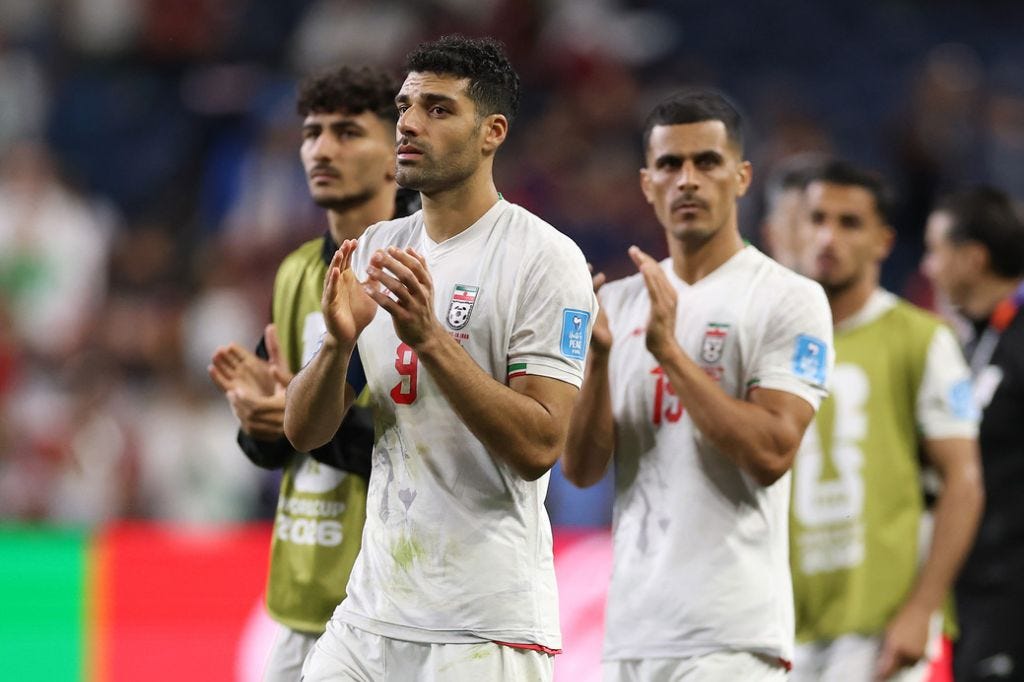
The 2026 World Cup was supposed to be football’s grand ritual of unity, a tournament where politics would be pushed to the margins and the game would speak for itself. Instead, for Iran, it became a grim lesson in how easily that promise collapses when power, prejudice, and opportunism take over. What should have been a celebration of sport was turned into a hostile political theatre, and FIFA as ever stood by with its hands in its pockets.
Iran’s treatment in the United States was not merely inconvenient. It was humiliating, punitive, and deeply damaging to the idea of fair competition. The team were forced into a bureaucratic maze of travel restrictions and logistical obstacles that no other nation had to endure in the same way. Their base camp arrangements, movement windows, and daily routines were disrupted in ways that compromised preparation, recovery, and focus. In tournament football, that is not a small matter. It is the difference between competing on equal terms and being made to fight with one arm tied behind your back.
The message from the Trump administration was not subtle. Iran were treated as a political problem first and a football team second. The use of visa controls, security pretexts, and administrative roadblocks created an atmosphere of intimidation around the squad, as though the Americans wanted to ensure that Iran’s presence on US soil would feel conditional, uncomfortable, and tightly managed. That is not the spirit of the World Cup. It is the spirit of a state using sport as an extension of its own foreign policy.
Iran’s staff were also hit hard. Support personnel vital to the daily functioning of an international team were denied entry, leaving the squad without some of the people responsible for the most basic elements of logistics, analysis, and player welfare. That is not just annoying or awkward. It is a competitive disadvantage deliberately imposed. Coaches can plan only so much. Players can adapt only so much. A World Cup should not require a team to spend half its energy navigating the host nation’s hostility before it even kicks a ball.
Iran’s head coach, Amir Ghalenoei, was right to say the team had been deprived of justice. Captain Mehdi Taremi was equally blunt in describing the World Cup as a disaster. Those were not the words of men looking for excuses. They were the words of people who had watched their team be placed in an environment that made ordinary preparation feel like an act of endurance. Their complaints deserved the full weight of FIFA’s attention. Instead, they were met with the usual fog of institutional evasion.
And that is where FIFA’s cowardice becomes impossible to ignore. The governing body loves to talk about peace, inclusion, and football’s unique power to unite the world. But the moment a member association is mistreated by a powerful host, the principles evaporate. FIFA becomes suddenly careful, suddenly vague, suddenly unwilling to say anything that might disturb the people paying for the spectacle. That is not neutrality. It is surrender disguised as diplomacy.
Gianni Infantino’s conduct makes the whole thing even uglier. The FIFA president has long behaved less like a steward of the game than a man obsessed with his own image, and his closeness to Donald Trump has only sharpened that impression. Infantino appears determined to keep himself at the centre of every ceremony, every stage, every photo opportunity, as though the World Cup exists partly to complete his personal brand. His silence over Iran’s treatment was not accidental. It was political. It was calculated. And it was cowardly.
The sight of Trump being booed at the Club World Cup final, standing awkwardly beside Chelsea players, only underlined how grotesque the spectacle has become. So too did the expectation that Trump will be front and centre when the trophy is handed over, with Infantino again playing the loyal courtier. The FIFA president seems far more interested in proximity to power than in protecting the integrity of the sport. He flatters presidents and despots with equal enthusiasm, as long as the cameras keep rolling.
That hypocrisy becomes even harder to stomach when set beside FIFA’s inconsistent discipline elsewhere. Nepal has been suspended over third-party interference, while Russia remains banned from senior international football following its invasion of Ukraine. FIFA is perfectly capable of invoking principle when it suits the institution’s interests or geopolitical comfort. It can punish, isolate, and moralise when the target is small enough or politically convenient enough. But when the issue is harder, messier, and more fraught, the courage disappears.
That is why FIFA’s refusal to take a meaningful stand on Israel has drawn such anger. There is a growing chorus demanding accountability, and protests have already made the point in public, loud and clear. Yet FIFA continues to hide behind procedural language and selective blindness. It is easier for the organisation to pretend it is above politics than to confront the reality that it has chosen sides by refusing to act. Neutrality, in this context, has become a cover for inaction.
The Palestinian voice, meanwhile, has been marginalised in precisely the way critics warned it would be. The refusal to grant a visa to the head of the Palestinian Football Federation to attend the World Cup was another act that spoke volumes. It sent a clear message about whose presence is tolerated and whose is treated as inconvenient. FIFA’s appetite for symbolic gestures is endless when it comes to photo opportunities. Its appetite for defending the dignity of those actually caught in conflict is far thinner.
The ugliest part of all this is how deniable it has been made to look. Every criticism can be waved away as political, inflammatory, or outside football’s remit. Every accusation can be met with empty talk about neutrality and unity. That is how cowardice survives, by dressing itself up as balanced. But the pattern is obvious. Powerful allies are protected. Convenient targets are punished. Small federations are disciplined. Large political contradictions are ignored.
Iran’s campaign was affected by more than tactics and form. It was shaped by a constant state of uncertainty, by restrictions that undermined preparation, and by the feeling that they were competing not only against their group-stage opponents but against the conditions imposed upon them by the host nation. That kind of pressure does not show up cleanly in the statistics, but it is there all the same. It settles into the legs, the sleep, the mind, and the margins that decide matches.
And yet the Iranian players carried themselves with dignity. They tried to keep the focus on football and were a whisker away from qualifying for the last 32. They showed moments of grace and solidarity that stood in stark contrast to the pettiness around them. That made their treatment all the more shameful. They were not asking for special treatment. They were asking for ordinary respect. In return, they were given obstacles, suspicion, and silence.
The 2026 World Cup will live in memory not just for goals and results, but for the way one of its participants was treated as a political inconvenience. That is a stain on the tournament, and FIFA should own it. If the World Cup is to mean anything beyond a lucrative global spectacle, the governing body must stop pretending that slogans are a substitute for leadership. It must stop hiding behind neutrality when neutrality is really just cowardice. And it must stop allowing its president to confuse self-promotion with authority.
A football institution that preaches unity while tolerating obvious imbalance is not defending the game. It is exposing how weak, compromised, and morally threadbare it has become.
Well said. Agree with every word - an absolute disgrace.