

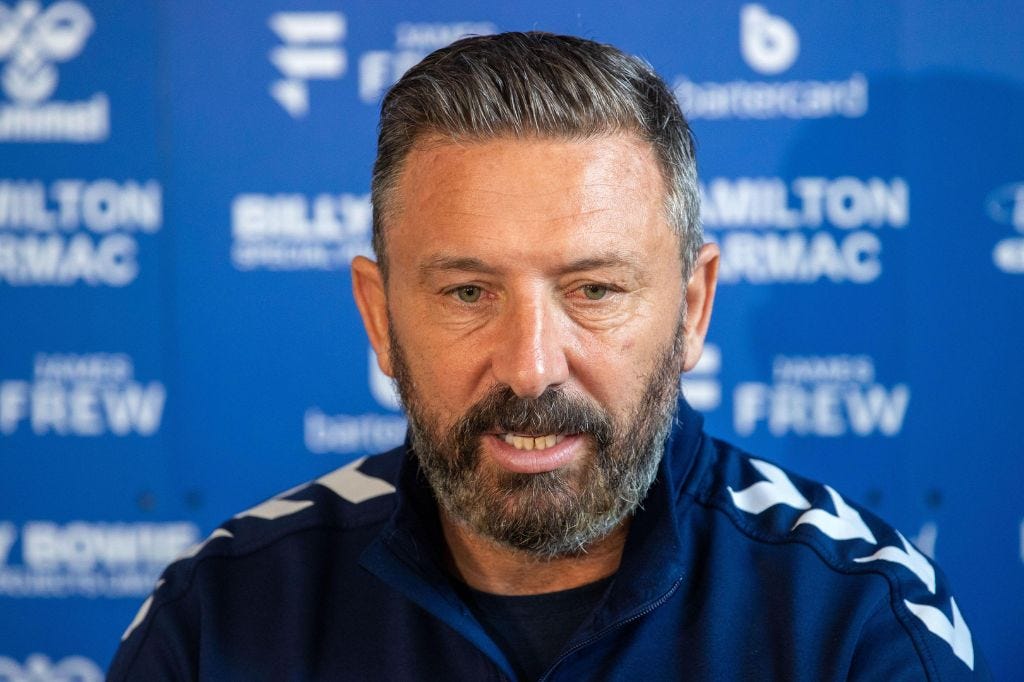
Rangers have a new manager. Again. Derek McInnes. In the time it takes most clubs to settle on a style of play, build a recruitment strategy, or even decide what shade of orange they want their third kit to be, Rangers have burned through two managers and welcomed a third. Russell Martin clocked in at a brisk 122 days. Danny Rohl, by comparison, was practically a relic of stability at 240.
And now, stepping into the chaos with a familiar face and a well-polished pair of brown brogues, comes Derek McInnes. The obvious question is not whether he will succeed. It is far more pressing, far more urgent, and far more in keeping with the new Rangers - how long will he last?
Because this is no longer a football club in the traditional sense. It is a revolving door with a dugout attached. A place where managerial appointments feel less like long-term visions and more like short-term bets placed by a board chasing relevance, credibility, and above all, Celtic. McInnes is the latest punt pushed into the Rangers hotseat.
The irony is almost too neat. After years of experimentation - the “modern progressive coach” in Russell Martin, the “tactical innovator” in Danny Rohl, the continental thinking, the data-driven approaches, the attempts to appear like a club with a coherent footballing identity - Rangers have arrived back where they always tend to end up. Comfort. Familiarity. A safe pair of hands who “gets it.”
Because that is the pitch, isn’t it? McInnes understands Rangers. He knows the expectations. He knows the pressure. He knows what it means. We are told this because he played 47 times for the club in the 1990s. Twenty-five of those appearances coming from the bench. Five years at Ibrox distilled into a narrative of belonging that somehow outweighs everything else - because he rode the coat tails of players who actually helped deliver trophy success while he failed to muster on average ten games a season at Ibrox.
It is a curious definition of legacy. But this is where Rangers as an institution and more importantly, Rangers as an idea becomes fascinating. The club repeatedly convinces itself that identity can substitute for excellence. That understanding the badge is as valuable as delivering results. That familiarity can bridge the gap that quality cannot.
McInnes fits that mould perfectly. Dependable. Respectable. Predictable. Because let’s be honest about Derek McInnes the manager. Strip away the Protestant mythology, the nostalgia, the soft-focus memories of the 1990s, and what you are left with is a coach whose career has been defined not by triumph, but by proximity to it.
At Aberdeen, he built a competitive side. He organised well. He maximised resources. He turned Pittodrie into a difficult place to go. All of that is true. But he never truly threatened Celtic. Not when it mattered. Not when the door was even slightly ajar. He finished second. Respectably. Repeatedly. Admirably, even. But he never kicked it down. He was, in every sense, the perennial bridesmaid - close enough to the occasion to be noticed, never central enough to define it.
And that is the contradiction at the heart of this appointment. Rangers, a club that measures itself almost exclusively against Celtic, have hired a manager whose defining trait is that he has never managed to get the better of Celtic. Yet here he is, presented as the man who “knows how to win.”
A manager that Celtic fans are supposedly fearful and scared of.
Win what, exactly? Matches? Yes. Moments? Occasionally. Titles? That is a different conversation entirely.
Rangers Chairman Andrew Cavanagh’s endorsement of McInnes as someone who understands what it takes to win in the league feels less like analysis and more like hope dressed up as certainty. Because if knowing the league was enough, McInnes would have a medal collection to match the rhetoric. Instead, he has a collection of near-misses and “what ifs.”
And now he has Rangers.
This, though, is not just about McInnes. It is about a club that has spent £40 million in a single season to finish third and leave trophyless, all while watching a Celtic side that, by their own supporters’ admission, has been erratic, inconsistent, and vulnerable.
If there was ever a moment to strike, that was it. If there was ever a season where Rangers could have imposed themselves, that was it. Instead, they stumbled. Again. And yet, somehow, the narrative resets. As it always does.
“This is our season.”
It has become less of a prediction and more of a ritual incantation, repeated annually since Steven Gerrard departed in 2021. Each season brings a new manager or two, a new rebuild, a new sense of inevitability that this time, finally, things will click. And each season ends the same way, with Celtic holding the league title aloft and Rangers explaining why next year will be different - as their fans cry foul about conspiracies and corruption at the SPFL and the Scottish FA.
McInnes is not immune to that cycle. In fact, he may be its most natural inhabitant. Because what Rangers have done here is not break the pattern, they have embraced it. They have gone from a big name with limited experience to internal projects, from continental thinkers to ideological experiments, and now, finally, to the fallback option - a manager who embodies familiarity over innovation. A return to what feels right in the eyes of their fans rather than what might actually work.
And wrapped around all of this is a deeper, more uncomfortable bigoted undercurrent - the persistent belief among sections of the support that success is tied not just to footballing ability, but to cultural alignment. That being the “right kind” of Rangers man - a Protestant Rangers man - carries weight beyond tactics, recruitment, or results.
It is an outdated and sectarian notion, but it lingers on at Ibrox. You can see it in the narratives that surround appointments, in the language used, in the subtle (and sometimes not-so-subtle) framing of what makes someone suitable for the role. McInnes, in that sense, ticks boxes that go far beyond football.
But ticking boxes do not win leagues. Structures does. Recruitment does. Stability does. Things Rangers have conspicuously lacked since the new club was formed under founder Charles Green.
Danny Rohl’s departure, in particular, should set alarm bells ringing. Here was a coach regarded as progressive, forward-thinking, and crucially backed by the hierarchy despite the post-split collapse at the end of the season. And yet, he chose to leave. Do you honestly think Rohl would have walked away from a well-run project? Abandoning clarity, stability, and a long-term vision. He has left because he didn’t like what he was seeing behind the scenes. He recognised that the environment at Ibrox is not conducive to success. He has clearly understood that no matter what he tried to build, the foundations beneath him were unstable. Rohl saw that. And he got out. Because he understood something that Rangers continue to ignore, this is not just a footballing problem. It is structural. Cultural. Institutional. Changing the manager does not fix that. It just resets the clock.
Rangers are driven less by strategy and more by urgency. Less by vision and more by fear of falling further behind. And so, McInnes arrives not as the architect of a new era, but as the latest attempt to stop the bleeding. Which brings us back to the original question.
122 days.
240 days.
How many days for McInnes?
The smart money says somewhere in between. Long enough to steady things. Not long enough to transform them. Because unless something fundamentally changes - not just on the pitch, but in how the club operates, recruits, and defines success - this story has already been written. A promising start. A run of solid results. Talk of “belief” returning. Then the pressure. The inevitable stumble. The familiar collapse. And finally, the search for the next man who “gets it.”
Derek McInnes may well bring order. He may even bring improvement. He may even bring his log in to Jamestown Analytics with him before Tony Bloom cancels his access. But if Rangers are expecting him to deliver what he has never delivered before - to not just compete with Celtic, but to surpass them across a full season - then they are not appointing a manager. They are buying into a hope. And hope, as Rangers have learned time and time again over the past decade, is not a strategy for success.
Agree with most of that Andy, but you mention structure, recruitment and stability they'll need to win the league, before WE get carried away, thats exactly what we need too.
Unfortunately our board are already tucked in and asleep at the wheel, ive pretty much gave up on reading about our transfers day to day.
When I awaken every day my first stop is Celtic News, not anymore!!!
IVE HAD ENOUGH FROM OUR BOARD.
The rangers or sevco