

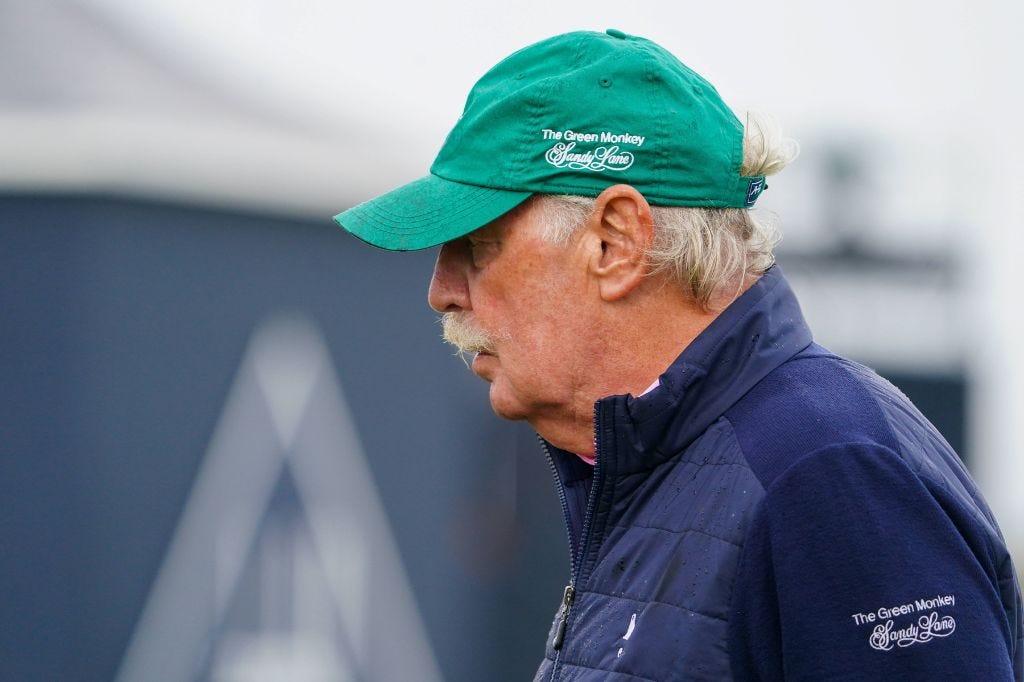
Dermot Desmond can ignore boos at Celtic Park because he is hardly ever there. He can dismiss banners, chants and social-media campaigns as the background noise of a support he has never truly answered to. But take the protest onto a golf course, place it in front of the professionals and wealthy circles he chooses to inhabit, and suddenly the response becomes immediate, personal and vindictive. That is what happened at St Andrews during the Alfred Dunhill Links Championship.
A small group of Celtic supporters disrupted Desmond’s round of golf by throwing tennis balls onto the course and displaying banners as part of the ongoing ‘Not a Penny more’ boycott. It was a targeted protest rather than an act of disorder - despite claims to the contrary. The point was made clear, the man widely regarded as Celtic’s most influential shareholder may remain beyond the reach of ordinary accountability at the club, but he is not beyond protest wherever he does.
And, judging by the speed and tone of Celtic’s subsequent statement on Sunday night, the protest landed exactly where it was intended to land - humiliating Desmond.
The place that matters most to Desmond
Celtic supporters have protested against Desmond for years. They have booed. They have sung about him. They have displayed banners at Celtic Park, criticised the board outside the stadium and challenged the direction of the club at AGMs. None of it has visibly shifted him.
That is partly because football is easy to keep at arm’s length when you are Dermot Desmond. He does not sit in the dugout. He does not front up to the media. He hardly attends a game. He does not put himself through an AGM grilling - preferring to send his nepo baby son nowadays. He does not have to answer the questions that Michael Nicholson, Chris McKay, Brian Wilson or whoever else is sent out to represent the hierarchy must attempt to navigate.
At Celtic Park, opposition can be framed as the usual noise of football. The disgruntled supporter becomes a nuisance. The banner becomes a minority view. The criticism becomes something to be managed through statements, stadium bans, closed-door meetings and carefully selected club messaging. St. Andrews was different.
This was not a chant from the back of a stand. It was not a protest outside the ground. It was not something that could be ignored by refusing to look in the direction of a banner. It was public embarrassment in an environment that matters personally to Desmond - golf, wealth, influence, celebrity, and status.
It forced course security to escort him away after the disruption. Whatever the exact private conversations were afterwards, the optics alone were humiliating for Desmond. A billionaire accustomed to controlling the environment around him was suddenly the focus of unwanted attention at one of the world’s most famous golf venues. That is why the reaction came so quickly.
Celtic’s badge, Desmond’s grievance
The statement issued in Celtic’s name was remarkable not because it condemned disruption, a football club is entitled to condemn a protest it believes crossed a line, but because of what it revealed.
It was long. It was deeply personal in tone. It repeatedly invoked Celtic’s reputation, the club’s history, the conduct of supporter groups and the need to protect employees, directors, shareholders and “others associated with Celtic.”
Most tellingly, it concluded: “The reputation of Celtic Football Club is non negotiable.”
That line is supposed to make the statement sound principled. Instead, it gives the game away. Celtic’s reputation was not damaged because a handful of supporters threw tennis balls onto a golf course. The overwhelming majority of people watching from outside the club will have understood precisely what it was - a protest aimed at a hugely influential figure who controls the football club.
What does damage the reputation of Celtic Football Club however, is Dermot Desmond’s control of the club, the board’s incompetence when it comes to player recruitment, long term strategy on and off the pitch, and the club’s continued failure in Europe.
There was no question of Celtic supporters storming an event, attacking participants or causing mass disorder. The protest was disruptive, yes. It was deliberately designed to make a point, yes. But the idea that it somehow dismantled a reputation built over more than a century is absurd. What it did damage was Desmond’s ego and reputation in front of pro golfers he pays to be around.
It put a spotlight on the contradiction at the heart of Celtic’s governance. Desmond is not the owner of Celtic Football Club. Celtic is a PLC. It has shareholders. It has a board. It has formal governance structures. It has an AGM. It has a support whose emotional, financial and cultural investment funds the club - if Desmond wasn’t there the club would continue to function, it would thrive, it would flourish - Yet the club’s public posture repeatedly suggests that criticism of Desmond is treated as an attack on Celtic itself. That is the problem.
Dermot Desmond is an enormously influential shareholder. He is not Celtic Football Club. He does not own its history, its identity, its community or the right to define who is and is not a legitimate supporter, he also cannot dictate to the fans what they can and cannot do. Celtic existed long before Desmond accumulated influence through his shareholding and it will exist long after he is gone - sooner rather than later hopefully.
Using the club’s official platform to respond to what was, in reality, a personal humiliation is exactly why so many supporters believe the lines between the club, the board and Desmond’s interests have become blurred.
A familiar pattern
This is not the first time Desmond’s displeasure has been communicated through the machinery of Celtic.
Last season’s statement against Brendan Rodgers had the same flavour - an extraordinary personal broadside delivered using the club’s letterhead. It was the language of Dermot Desmond making clear that he had been crossed. The statement after the St.Andrews protest has Desmond’s fingerprints all over it.
The target may officially be the Celtic Fans Collective, but the emotional centre of the statement is not the club’s governance, fan engagement or operational strategy. It is the fact that Desmond was targeted while playing golf in a private capacity and was humiliated.
That is why the repeated references to Celtic’s reputation ring hollow. If the priority were genuinely the club’s reputation, the board would be much more concerned about the issues supporters have raised for years.
Instead, the club has chosen to declare war on a supporter collective after a protest that embarrassed a shareholder at a golf tournament. That is not a defence of Celtic’s reputation. It is a reaction to protect Dermot Desmond’s status.
The AGM will expose the reality
This year’s AGM is likely to be fractious, and rightly so. Desmond will avoid the scrutiny himself, as he has done time and time again. The task of fronting the room will fall to the board fronted by interim chairman Brian Wilson, and Dermot’s nepo baby Ross, who has increasingly been positioned around the club’s upper structures by his father. A clear sign that Dermot is shoehorning his son into the club to take over from him sooner or later.
That alone will infuriate many supporters. The idea that a club of Celtic’s scale could be represented by another member of the Desmond family while the most influential figure continues to dodge direct challenge and accountability will reinforce the belief that the club is being treated as a private family’s play thing rather than a public institution with obligations to shareholders and supporters.
Peter Lawwell, whatever supporters thought of him, had authority. He had presence. He had experience. He understood the political and commercial landscape of the game. He carried influence in Scottish football and beyond it. The current boardroom does not project the same strength, it projects no strength whatsoever. Puppet rulers doing their overlord’s bidding.
Michael Nicholson, Chris McKay, Brian Wilson and the rest may hold official titles, but the perception among a large section of the support is that they are managing Desmond’s position and vision for the club rather than shaping Celtic’s future for the club’s own benefit. That perception becomes harder to dismiss every time the club produces a statement that reads more like a billionaire spitting the dummy than a football club’s considered response.
The AGM should be the place where the board answers for recruitment, investment, sporting ambition, supporter engagement and strategy. Instead, there it will almost certainly be another stage for Desmond [through his son] talking down to supporters while the central questions go unanswered.
Whether the AGM is done in person or online is another talking point. Either way, Desmond & co will escape accountability once again.
Protest, power and unity
There is a legitimate debate to be had about the tactics of the Celtic Fan Collective. Some supporters will feel the St Andrews protest went too far. Others will argue it was an effective piece of direct action because it did what years of stadium protests failed to do - it provoked Desmond. Both views can exist.
But the bigger lesson is obvious. The protest has shown where Desmond’s pressure points are. He may not care about a hostile atmosphere at Celtic Park in the same way he cares about being embarrassed in a prestigious golfing environment, among people whose opinions matter to him more personally.
That does not mean every protest should now be exported to a golf course. It does mean supporters have been reminded that the existing power structure is not as untouchable as it likes to appear. The difficulty, as ever, is unity.
There are too many fan groups within the Celtic fanbase, too many agendas, too many competing campaigns and too many different ideas about how change should be pursued. The Green Brigade & the Celtic Fans Collective, shareholder groups, season-ticket holders, occasional matchgoers and supporters who follow from home all want Celtic to be better. But wanting the same outcome is not the same as operating as one force. That fragmentation of the fan base actually helps the board.
A divided support can be dismissed as a collection of minorities. One group can be banned. Another can be criticised. A third can be invited into selective dialogue. The board can always claim it is engaging with “responsible” fans while deciding for itself who qualifies as responsible. A united support is almost impossible to manage.
The most meaningful leverage remains financial and institutional - coordinated shareholder action, sustained pressure at AGMs, disciplined campaigns around governance, and in theory a significant downturn in season-ticket renewals or market confidence. The problem is that supporters are emotionally tied to their seats, their routines and their club. Most will not surrender that connection, even if they are furious with those running it.
The same applies to the PLC share price. A serious collapse in value would change the tone quickly, but it remains unlikely without a much wider commercial or footballing crisis. So the board’s current tactics is understandable, it believes the anger will pass, the tickets will continue to sell, the money will continue to flow and Celtic’s dominance at home will keep discontent manageable. St Andrews was a warning that not everyone accepts that calculation.
Celtic are not going away
The most revealing aspect of the club’s statement is its insistence that supporters cannot “intimidate or coerce” the club. That language is designed to turn a governance dispute into a morality play - respectable club versus irresponsible agitators; historic institution versus self-appointed groups; sensible dialogue versus escalating disruption. But that framing avoids the real issue.
Celtic supporters are not asking for permission to care about the club. They are not required to accept that questioning the board, challenging the use of money, demanding strategic ambition or criticising a powerful shareholder somehow makes them a threat to Celtic.
The club belongs to its support in every meaningful sense - emotionally, culturally, and historically. Directors come and go. Executives come and go. Shareholders come and go. Supporters remain.
Dermot Desmond may have been humiliated at St Andrews. He may have responded by using Celtic’s official platform to take aim at the Celtic Fans Collective. He may now seek to make an example of those involved through indefinite bans and the withdrawal of recognition. But the real outcome may be the opposite of what he intended.
He has shown supporters that their protests can reach him. He has shown that the carefully managed distance between Desmond and Celtic can collapse very quickly when his personal world is affected. And he has reminded everyone that the most powerful man around Celtic Park is still deeply sensitive to public challenge. The tennis balls did not damage Celtic’s reputation. They punctured Dermot Desmond’s aura of invulnerability and his ego.
I agree with all points in this post, especially about one director having too much influence and no direct way to engage with him.
Just to add, I feel the aspects that are damaging Celtic's reputation are our failed attempts to make the champions league, becoming known to be difficult to deal with by other clubs and agents for our prolonged transfer negotiations and our failure to replace key roles - CEO, director of football, even fitness coach.
Great piece brother. My good lady has expressed some of the sentiments herein for her piece later on today. Fantastic assessment of the situation. The question we need to consider now, as you've said, is what comes next? We're all going to have to grapple with that one.