

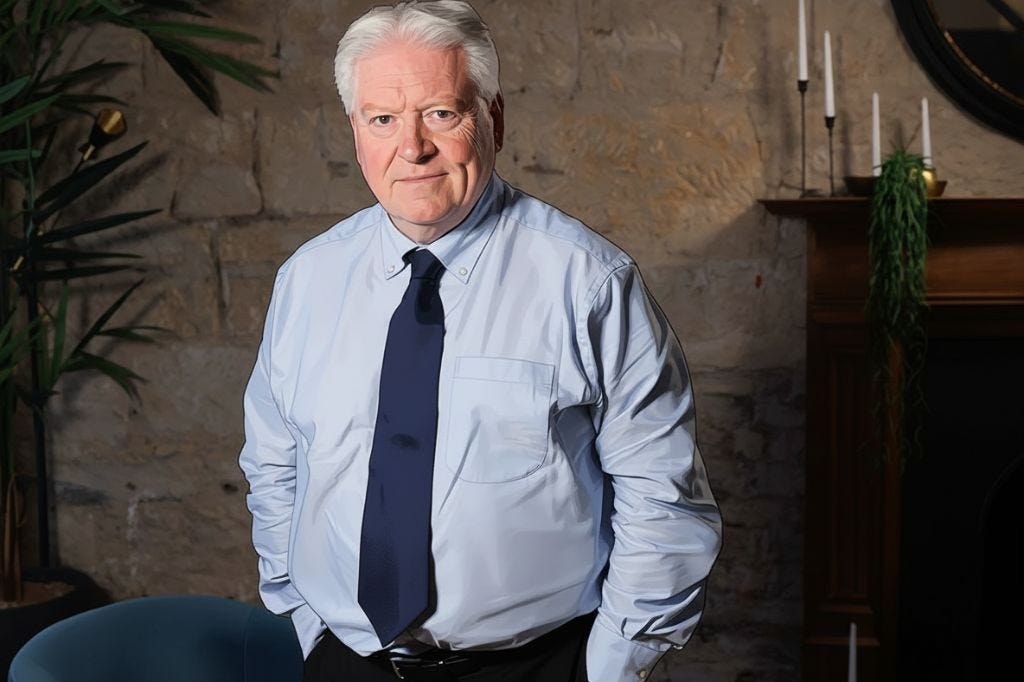
Respected broadcaster and lifelong Celtic fan Bernard Ponsonby didn’t just criticise the Celtic board this week, he dismantled the comfortable narrative that has shielded them for years.
And he did it not as a ranting fan on social media [including yours truly], but as a measured, established voice speaking in a room full of Celtic supporters, under the banner of supporting the club’s own charitable foundation.
That matters.
Because when someone like Ponsonby says the problem is no longer “ultras” or fringe discontent, but the “core of the support,” then the ground has shifted beneath the board’s feet.
For too long, dissent at Celtic has been conveniently boxed off. Ultras. Malcontents. Online noise. But Ponsonby’s intervention strips that away. What he articulated calmly is that dissatisfaction has gone mainstream. This is no longer agitation from the margins. It’s erosion at the centre.
And yet, crucially, he also dismantled the lazy solution.
“Sack the board” is a slogan, he said. Not a strategy.
He’s right. And most supporters, if they’re being honest, know it. The idea that an AGM revolt will suddenly transform Celtic is fantasy. The ownership structure, the voting power, the reality of Dermot Desmond’s influence - it all but guarantees continuity. You can change faces, but without a shift in the underlying model, nothing fundamental changes.
That’s the real tension Ponsonby exposed. Because this isn’t simply about personalities. It’s about philosophy.
For 25 years, Celtic have been run on a model that prioritises domestic dominance, financial stability, and controlled risk. And in that narrow sense, it has worked. The trophy haul is undeniable. The balance sheet is healthy. The club has avoided the chaos that has consumed and killed off others.
But that same model has calcified.
Repeated European failures are not accidents. They are outcomes. When Ponsonby points to Celtic’s inability to consistently compete with clubs operating on smaller budgets, he’s not highlighting bad luck he’s pointing to structural conservatism. A club that manages risk so tightly that it ultimately limits its own ambition.
And here’s where his speech cuts deepest, domestic success is no longer enough.
Celtic supporters don’t measure themselves purely against Kilmarnock or St Mirren with respect to these clubs. They measure themselves against history, identity, and European nights that once defined the club’s global reputation. Lisbon wasn’t built on cautious accounting. Nor were the great modern nights from Barcelona to Juventus born out of risk aversion.
Ponsonby understands something the board increasingly appears not to, Celtic is not just a business, and it cannot be run like one in isolation from its culture. That’s why his most powerful argument wasn’t about governance or finance. It was about meaning.
He spoke about the “almost spiritual quality” of the club. About the Foundation as the embodiment of Celtic’s purpose. About supporters not executives as the club’s greatest ambassadors. This wasn’t sentimentality. It was a reminder.
Because when supporters begin to feel disconnected - not just from results, but from values - you have a deeper problem than a poor season or a failed transfer window or two. You have a crisis of identity. And that’s where the board’s biggest failure lies.
Communication.
Ponsonby’s criticism of “absentee landlords and their offspring reading the Riot Act” was as pointed as anything said all night. It speaks to a leadership that feels distant, reactive, and at times tone-deaf. In an era where football clubs are expected to engage, explain, and at least acknowledge their supporters, Celtic’s hierarchy too often retreats into silence or condescension. That approach might have worked in the past. It doesn’t now.
Perhaps the most telling line in his entire speech wasn’t about Europe, or Desmond, or governance structures. It was that for the first time in his life, he questioned renewing his season ticket. He immediately qualified it - he will renew, of course. Just as tens of thousands of others will. But the fact the question is even being asked is the warning sign.
Because Celtic’s power has always rested on something deeper than results. A loyalty that transcends logic. A connection that survives bad teams, bad managers, even bad custodians.
But that connection is not indestructible. It can be strained. It can be eroded. And if it is taken for granted for long enough, it can fracture.
Ponsonby didn’t call for revolution. He explicitly acknowledged the risks of change, the uncertainty of new ownership, the lack of obvious alternatives. But what he did do was articulate a truth that is becoming harder to ignore.
The current model has reached its limit. And unless those in charge recognise that -unless they evolve, communicate, and realign the club with the expectations and identity of its support - then the turbulence he referenced won’t simply “settle.”
It will deepen.
Because Celtic, as he reminded everyone in that room, is not defined by its boardrooms or balance sheets. It is defined by its fans. And right now, those fans are no longer content to be ignored.
Listen to Bernard Ponsonby’s speech in full: