

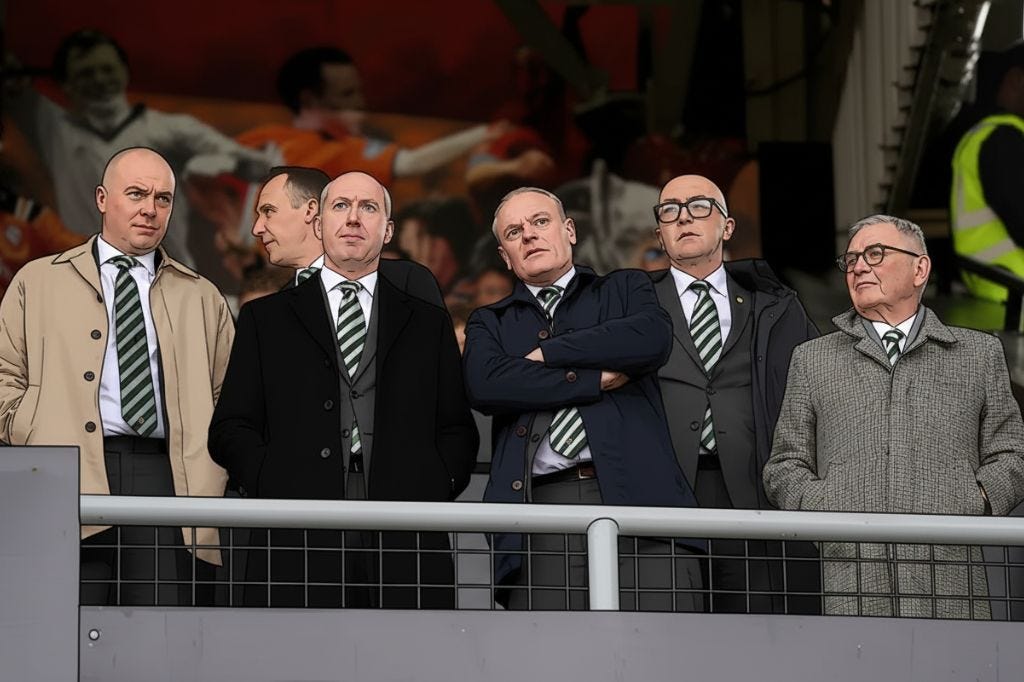
For years, Celtic’s hierarchy have told us about “world-class ambitions.” They’ve spoken about modernisation, innovation, and progress. Yet as this season collapses into calamity, those words sound more hollow than ever. This season, Celtic’s decline has been self-inflicted with a cocktail of boardroom cowardice, footballing negligence, and commercial obsession that’s left the club staring at third place and staring into the abyss.
Instead of fixing the mess on the park, the board has doubled down on what it knows best, trying to protect its revenue streams, its gravy train. The latest appointment - Paul Mazoyer as Head of Business Operations - tells you everything you need to know about where Celtic’s priorities lie.
Mazoyer arrives from Heineken, where he spent five years as Head of Customer Care - a grand title for someone who managed complaints and service standards - prior to a three-month stint as Head of On-Trade Operations. Now, he’s in charge of supporter services, retail, ticketing, hospitality, and stadium operations at one of football’s biggest institutions. His remit? To “drive supporter service and commercial performance” and deliver “world-class supporter services.”
For a fanbase crying out for leadership in recruitment, coaching, and football strategy, this appointment will feel like another slap in the face. Mazoyer may be perfectly competent in the customer service world, but he has zero experience in football operations - no record in matchday management, no background in ticketing, no understanding of retail and ecommerce operations, let alone the culture or tribalism that fuels a club like Celtic. That’s not his fault. It’s the board’s.
If Michael Nicholson truly wants a “world-class operation,” why does he keep hiring people who’ve never worked in football or if they have at a level even lower league English sides would turn their noses up at? After the Wilfried Nancy debacle - a 33-day disaster of an appointment - you’d think lessons had been learned. Clearly not. Celtic don’t need another customer care executive. They need a director of football, a head scout, and a manager. The football department is an empty shell, and the results are now reflecting that - with all due respect to the work that Martin O’Neill and his team have done.
The irony is painful, in the same week as Celtic’s title defence effectively ends, the board polishes its spreadsheets and pats itself on the back for appointing another suit that will help to safeguard revenue. They won’t talk about the effect of fan protests on finances - the interim report was conveniently vague as it always is - but you can be sure the priority now isn’t rebuilding the team, it’s protecting their bottom line.
And what’s left of the football? Nothing resembling the Celtic fans cherish. No flair. No fire. No style. Just another timid, shambolic season ending in mediocrity. The board are accountants and lawyers first, custodians of the club as a side job.
Paul Mazoyer might be an excellent customer service manager, but Celtic isn’t a call centre. It’s a football club. The product is football, not how quickly you can answer a phone or serve an overcooked scotch pie full of hot oil. Fans don’t buy into slick customer service scripts or buzzwords like “supporter engagement.” They crave wingers who beat their man, midfielders who fight for every ball, and strikers who live for goals. They want heart, courage, and ambition - not another layer of corporate padding between them and a board that are well and truly out of touch with the supporters. They didn’t even have the balls to look at the fans after today’s 2-0 defeat to Dundee United at Tannadice.
The tragedy is that the fans - the lifeblood of this club - aren’t even treated as customers by those who run it. The board didn’t invest properly last summer, blew the Champions League qualification, lost Rodgers, signed cereal-box players under Paul Tisdale’s amateur hour, and turned one of the world’s biggest clubs into a laughing stock. Now with no European riches on the horizon and the £70 million dream fund set to evaporate, they’ll soon realise that even accountants can’t balance the books when the product dies.
Come the summer, a full-scale overhaul of football operations is the only way Celtic can recover. But history tells us not to hold our breath. The club that once prided itself on being “more than just a football team” has become an exercise in crisis management and corporate self-preservation. Duct tape and gorilla glue won’t fix this one.
I think the Celtic Board wrote off this season privately after the Nancy debacle.
That defeat today has finished us, we don't deserve to win the league, it's been an annus horriblis year for Celtic fans.
It's a dogfight between Rangers and Hearts now, and I fancy Rangers with their stronger squad to do the business now. Hearts will be quite happy to finish 2nd in the league, it will still be a gateway for them potentially to the Champions League.
Andy, I agree with 99% of what you write in this post but, much as I hate to quibble, there is one sentence which I believe could benefit from greater precision, “Duct tape and Gorilla glue won’t fix this one.” I have taken the liberty of pricing each of these items at my local B&Q: Duct tape per roll £10.50, Gorilla glue per tube £9.08 making a grand total of £19.58. Andy, in what kind of warped universe do you see the Celtic Board authorising this volume of expenditure when chewing gum and string can be acquired gratis from terracing debris? If you ask me this looks like the kind of saving Paul Mazoyer our new Head of Business Operations should be addressing on day one if he wants to catch the eye of glorious leader’s Private Equity Company ‘International Investment and Underwriting’ which owns the 34.7% Shareholding in the Club Like No Other.