

Celtic’s annual accounts arrive carrying the familiar reassurance of a healthy bank balance: £66.4m in cash, negligible borrowings and the financial security most Scottish clubs can only envy. Yet beneath that comfort lies a more troubling picture. Revenue has fallen by almost £33m, operating costs have continued to rise and a club that made nearly £34m in profit a year ago has reported a £4.8m loss.
The immediate explanation is obvious. Celtic were playing Europa League rather than Champions League football, and the cost of that downgrade is written across the accounts - media income alone fell by £24.6m. But the more difficult question is not whether Europe has hurt Celtic financially. It is why a club with such resources, a dominant domestic position and a vast supporter base continues to leave its most important revenue stream vulnerable to the uncertainty of one qualifying tie.
Brian Wilson, Celtic’s interim chairman, presents the results as the consequence of a turbulent season navigated with resilience. There is truth in that. There was a title won in dramatic fashion, a Scottish Cup lifted and managerial chaos overcome. But the accounts also demand a less charitable reading - one of rising costs, reduced returns from player trading, delayed leadership at board level and a growing sense that Celtic’s financial strength has not been matched by clarity or urgency in how the club is run.
The scale of the decline is difficult to ignore. Ticketing was broadly stable, falling only marginally from £49.8m to £49.1m, a testament to the loyalty and spending power of Celtic’s support. But commercial and sponsorship income slipped from £36.1m to £31.7m, while stadium operations fell from £10.5m to £7.8m. The biggest hole was, inevitably, European media income.
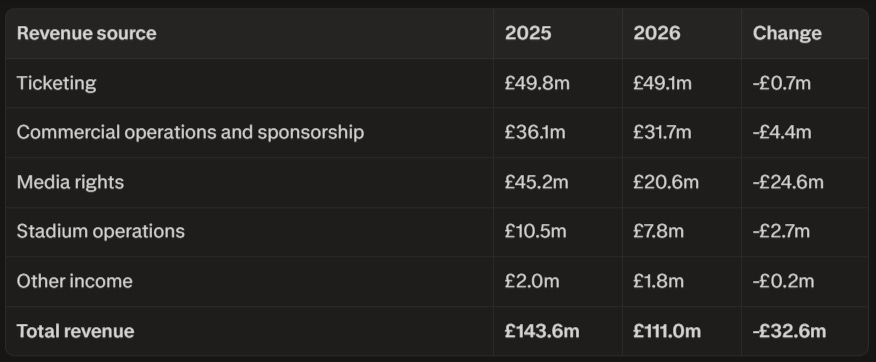
The figures reveal something else, too. Celtic’s income fell by 22.7%, but operating expenses rose by 4.3%, from £117.1m to £122.1m. That is the uncomfortable arithmetic at the heart of these accounts. The club’s cost base grew while its principal revenue stream dropped.
There are reasonable explanations. Football wages do not disappear simply because of the failure to qualify for the Champions League. Players remain under contract. The cost of operating Celtic Park, maintaining facilities, developing academies and running a large football club remains substantial. Nor should a club such as Celtic instinctively slash spending at the first sign of lower European income if doing so would make it still less competitive.
But that leads to the question the chairman’s statement does not properly confront. What was the purpose of carrying rising costs through a year of reduced income? If it was to build a stronger side, regain Champions League status and establish greater consistency in Europe, then Celtic must be judged on whether that objective was achieved.
The answer, from the latest evidence, is grim. Celtic have once again failed to reach the Champions League league phase after losing the 2026/27 play-off to LASK, consigning themselves to another season in the Europa League. Reports after suggested the club could lose out on around £20m to £25m compared with the income available through Champions League participation, before the full matchday and commercial consequences are considered.
The 2025/26 accounts are therefore not simply a historical document. They are a preview of the problem Celtic will ultimately face again. The club has shown that one year outside the Champions League can turn a £33.9m profit into a £4.8m loss. A second consecutive year of diminished European income would not make Celtic poor, but it would make their financial position less comfortable and expose the limits of a strategy built around reserves rather than regular success.
Celtic’s cash balance remains the obvious counterargument. The club ended the year with £66.4m in cash and cash equivalents, down from £77.3m but still formidable by Scottish standards. Borrowings were negligible at £96,000. Total equity was £150.9m. The directors say they have adequate financial resources, undrawn banking facilities and no material uncertainty over the club’s ability to continue as a going concern.
All of that is reassuring. Celtic are not a club in distress [financially at least]. They are not dependent on a bank overdraft, a distressed asset sale or outside rescue money. They possess significant financial strength, substantial infrastructure and one of the most dependable supporter bases in British football.
But there is a difference between being solvent and being well run. There is also a difference between holding cash and using it wisely.
The club invested £24.1m in player registrations during the year, compared with £37.8m the previous season. Wilson described committed player-acquisition costs, including agent fees, of £17.5m, following £42.6m in the preceding year. He attributed some of that reduced spending to a strategic decision in January to pursue loan deals with options to buy.
There is logic in the approach. Loans can provide flexibility, reduce transfer risk and give a club time to evaluate players. But in a season already unsettled by managerial turmoil and instability, supporters look at that argument differently. Flexibility can be sensible. It can also become a clear sign of indecision.
Celtic’s recruitment has rarely been judged simply by its gross spend. Supporters have watched enough transfer windows to know that a higher figure does not guarantee a better player or team. The more important questions are whether players arrive early enough, fit a coherent football plan and improve the side in areas of obvious weakness.
Those questions become more pressing when the consequences of failure are so expensive. The club’s latest report lists a £31.6m outlay on permanent signings after the year end, with Kasper Høgh, Camilo Duran, Mika Baur, Haïssem Hassan, Joël van den Berg and Jordan Lotomba among those brought in. There were also several loan additions. This is not the activity of a board without resources.
It is, however, the activity of a board that has committed itself to spending after losing the revenue stream best placed to finance such investment. Celtic may be able to absorb that decision because of their cash reserves. The question is whether they can afford to keep making it without a clearer route back to the Champions League.
Player trading also exposed another vulnerability. Profit on the disposal of intangible assets - football accounting language for player registrations - fell from £31.5m to £16m. Celtic still made useful sales, but their profit from player trading was almost halved. In a year when UEFA income dropped, that reduction mattered.
The modern Celtic model has depended on the club finding players at a price it can afford, improving them, competing successfully and selling some at a profit. It is a model that can work exceptionally well when coupled with Champions League income. But it becomes fragile when the club loses Europe’s biggest prize and does not generate enough transfer profit to compensate.
The danger is not that Celtic are running out of money. The danger is that their financial advantage becomes a cushion for recurring failure rather than a platform for avoiding it. They can survive bad decisions longer than rivals. That does not make those decisions less damaging.
Wilson’s statement, naturally, looks for the positives. He praises the team’s dramatic title triumph, the Scottish Cup win and the resilience shown after a turbulent period that included Brendan Rodgers’ departure, Wilfried Nancy’s ill-fated and short-lived spell, and Martin O’Neill’s return. The football story was undeniably chaotic. Celtic won the league and cup double in circumstances that would have tested any club.
But the language of turbulence risks becoming too convenient. Turbulence is something that happens to an organisation. The events at Celtic were caused by decisions made within it.
A manager left unexpectedly. His replacement did not work. The replacement was moved on. An emergency return was required from Martin O’Neill. The club missed out on the Champions League. The board has spent nine months without appointing a permanent chairman. Those are not separate incidents; they are signs of a board struggling to offer the stability it demands from its managers and players.
Peter Lawwell left the board on 31 December 2025. Brian Wilson became interim chairman on 1 January. Now, almost nine months later, Wilson remains interim chairman, while his own statement speaks of a continuing process to identify his successor.
That is not a minor administrative delay. Celtic is the largest club in Scotland, a publicly listed company and an organisation whose football and commercial decisions carry multi-million-pound consequences. A permanent chairman is not a ceremonial extra. The role matters in setting culture, supervising executives, guiding long-term strategy and ensuring that the club responds coherently in periods of instability.
The recent additions of Mark Keane and Raymond Buchanan to the board may strengthen it. Keane has been appointed immediately, while Buchanan is due to join after concluding his current role. But neither move addresses the lingering vacancy at the top.
Celtic may call it a board refresh. Supporters are entitled to call it a delay.
The issue is particularly acute because Wilson has spoken about communication and supporter engagement. The club has launched a new app, continued work on digital initiatives and established refreshed structures, including Celtic Connect. None of that is unhelpful. But a supporter survey, a digital platform and a new engagement group do not substitute for clear accountability and transparency from the board.
Supporters are not asking merely to be heard. They are asking to see evidence that the people running the club understand the scale of their frustration and are prepared to explain their decisions. Why has it taken so long to find a chair? What is the board’s football strategy? What are the targets for recruitment, European qualification and wage control? How will the club avoid entering a third transfer window with uncertainty clouding fundamental decisions?
The finances make the question of supporter discontent more relevant. The Not a Penny More campaign has become a visible expression of anger among sections of the Celtic support, particularly around the perception that a wealthy club has not matched its resources with enough urgency or ambition on the football side.
It would be wrong to claim these annual accounts prove the campaign has inflicted significant financial damage. They do not. The results do not isolate boycott-related revenue, and the broad fall in commercial, stadium and media income can be explained far more directly by the drop from Champions League to Europa League football.
Ticketing revenue also remained remarkably firm, falling by less than £1m. That suggests Celtic’s core supporter commitment remains resilient, even amid obvious dissatisfaction.
But a campaign does not need to be visible as a separate line in the accounts to matter. Its effect may be felt in discretionary spending - fewer shirts bought, less hospitality consumed, lower food and drink sales, smaller retail baskets and reduced willingness to spend beyond the season ticket. It may be felt commercially, in the wider atmosphere around the club and in the sense that supporters are increasingly unwilling to accept being treated as a reliable revenue stream regardless of performance.
The more significant impact may be political. The campaign reflects a relationship under strain. Celtic’s board may be protected by a large cash reserve and a strong season-ticket base, but it cannot assume that these advantages are inexhaustible.
Celtic’s supporters are the reason the club continues to operate at a financial level far beyond much of Scottish football. They fill the stadium, drive merchandise demand, create an international commercial identity and make European nights lucrative occasions. The £49.1m in ticketing revenue is not simply a line in a report. It is a measure of their commitment. That commitment should not be confused with contentment.
The accounts contain no sign of imminent financial danger. They do show a club with the means to recover, provided it learns the right lessons. Celtic remain well capitalised, lightly indebted and able to invest. Their core business remains unusually robust. They can still dominate domestically and compete in Europe.
But the results show what happens when the club misses the Champions League and fails to offset the loss with tighter cost control or stronger player trading. A £32.6m revenue fall, an operating loss before player-related accounting and exceptional items, and a £10.9m reduction in cash should sharpen minds.
Wilson is correct that Champions League failure has been costly. He is less convincing when he presents it as though it were an unavoidable external misfortune. The real issue is whether Celtic are organised well enough to make qualification the expected outcome of their resources, rather than the fragile reward of a good year.
In any other business, a collapse in annual revenue of more than £32m, a swing from almost £34m profit to a loss, prolonged uncertainty at board level and the failure to protect the company’s most valuable income stream would invite an immediate reckoning. Shareholders would demand answers. Directors would face serious questions about strategy, oversight and competence. A vote of no confidence, whether formal or informal, would become a plausible route towards change.
Celtic do not operate in that kind of environment. The club is publicly listed, but its power structure is anything but broadly democratic. Dermot Desmond’s holding, allied to the substantial stakes and influence of figures closely associated with the existing board, gives the controlling interests an authority that ordinary shareholders and supporters cannot realistically challenge through the ballot box.
That is why the arguments around Celtic’s finances so often feel circular. Supporters can voice anger, withhold discretionary spending, organise campaigns and press the club through supporter bodies. Minority shareholders can ask questions at an AGM. But unless the club’s dominant power base chooses to change course, there is no straightforward mechanism for forcing it.
The uncomfortable conclusion is that Celtic’s board does not face the market discipline that might confront directors elsewhere. Its position is underwritten by a controlling structure, by the reliability of the support and by the knowledge that the club’s considerable cash reserves can absorb mistakes for longer than most. That may protect Celtic from financial instability. It does not protect the club from institutional complacency.
For Celtic, the issue is no longer whether there is money available to make better decisions. The accounts make clear that there is. The question is whether those with the power to make them believe they have any obligation or are willing to do so.
Hi Andy,
Great summation and article, thank you.
Some queries for myself:
The player acquisitions of c.£31.6m are post 30/6 and shall be reported on the 2026/27 interim and full results. It is my understanding (correct me if I am wrong),that football transfers are generally paid on a 40/30/30% basis unless specifically negos on all cash up front (e.g. KT: c.£24.3m transfer to Arsenal). Does that not seems smoke and mirrors / political spin / gaslighting?
It highlights the decision to not back BR with an additional c.£10-£15m in the summer of 25, transfer window, sell Maeda for c.£15m - £20m (think Wolfsburg was the reported team) and Arne Engels to Notts Forrest for c.£22m - £25m (Jan 26, if reports are correct, due to not being able to get appropriate replacements in, despite knowledge that both players wished to leave the club), as gross incompetence and a strategy which is completely inappropriate for the football transfer market and a club with a >£111m turnover.
When you benchmark Celtic against similar European peers (e.g. Club Brugge, Atlanta, Eintracht Frankfurt, Lille and RB Salzburg, even Bodo Glimt), our player trading model and recruitment results are extremely poor.
Do you know where the figure of c.£42.6m in expenditure for y/e 2025 originates from? Barrowfield improvements would be amortised over the life cycle of the project or in line with the Capex guidelines from HMRC? It does not appear to have been spent on players (unless I missed that, from last year’s full accounts)?
A club like Celtic should not be bringing in 6–10 players every transfer window. Surely you need more stability and a core base of sell 2, bring in 4, maximum 6 players, as we have done this summer (5), with 5 additional loan players. That in itself outlines a complete lack of strategy and competence? How can you integrate so many players in such a short space of time?
To not prepare for the most important game of the season (CL qualifier), not qualify for 8/10 times (16-26), that is gross negligence in any other profession and would lead to an independent or NED review and appropriate restructure (possible dismissals).
That is without discussing the playing side of things, which have regressed since Jan 24, at an alarming rate. This strategy of just enough (+1 domestically), not preparing for Europe, constant downsizing, competent personnel in key positions and structure (e.g. Professional Head of Recruitment / Football operations and Head of Fitness and Conditioning, Hof Tactics and Analytics), can not continue without severe consequences. The past 2 weeks have shown that. It is as though we are an analogue club in the Digital / AI world. Honda Civic has been downsized to a Nissan Micra!!