

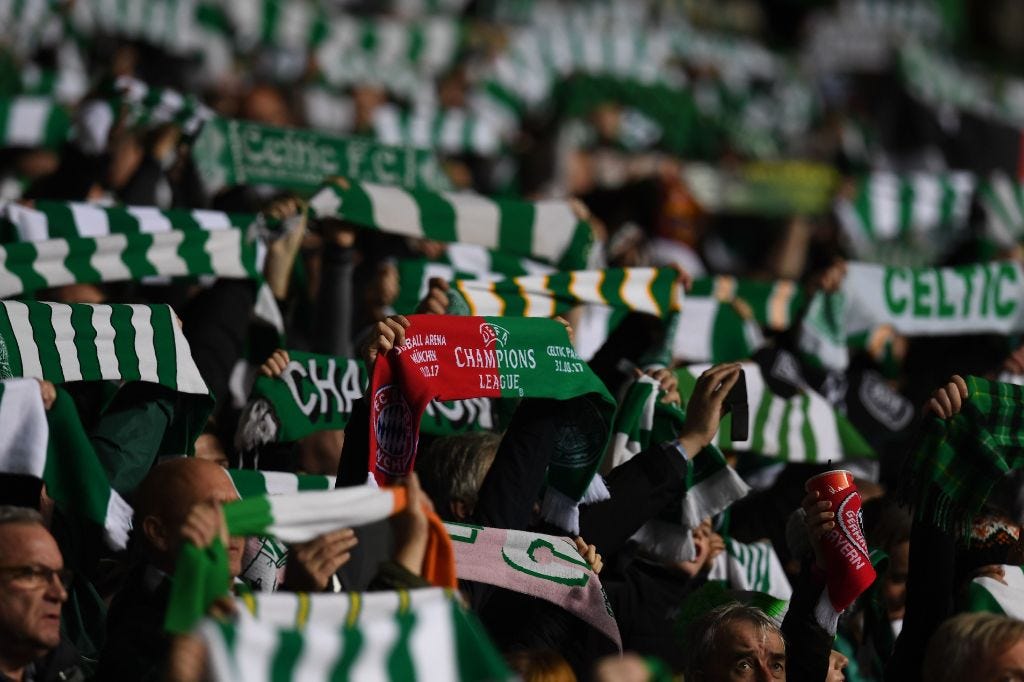
There is a contradiction at the heart of Celtic Football Club’s relationship with its supporters.
On one hand, Celtic presents itself as a club built on community, identity, history and belonging. It celebrates the passion of its supporters, the songs, the displays, the traditions and the global reach of the Celtic family. The club’s commercial machine is built around that emotional connection. Every new shirt, season-ticket campaign, European night and heritage product depends on supporters feeling that Celtic is not simply a football team, but part of who they are.
On the other hand, those same supporters are increasingly being treated as if they are an inconvenience, a hindrance, a headache, a thorn in the side of the board, as the enemy.
Fan bloggers, podcasters, vloggers, independent journalists, social-media creators and ordinary supporters who have spent years promoting the club are being pushed further and further away. Access to matches, interviews, training sessions, player appearances, club legends and official facilities is tightly controlled. Opportunities that were once available to independent fan media are now once again reserved exclusively for the club’s own platforms and traditional media organisations.
The commercial logic behind this is obvious. Celtic operates in a relatively small domestic market. It cannot compete financially with the Premier League, La Liga, the Bundesliga or the largest clubs in Europe. Every commercial opportunity matters. Every piece of content has potential value. Every interview, image, video and exclusive access opportunity can be used to drive traffic, subscriptions, sponsorship, advertising, merchandise sales and engagement with Celtic’s own digital channels.
That reality is understood by anyone who has worked in e-commerce or digital media. I have worked commercially online for around two decades [not OnlyFans!] and spent much of the past ten years in senior e-commerce roles. I have worked with limited budgets, stretched resources and demanding commercial targets. I have also worked in environments where funding was more plentiful. I understand the need to maximise revenue, protect intellectual property, build first-party audiences and make sure investment in content delivers a return.
What I cannot understand is the apparent belief that the best way to maximise Celtic’s commercial potential is to lock out the very people who have spent years creating content around the club - it is a commercial gold mine.
Control Is Not the Same as Strategy
There is nothing wrong with Celtic developing its own media operation. The club should have a strong website, a compelling app, an improved Celtic TV platform, a podcast network, a modern Celtic View and a first-class social-media operation. It should own and control its key commercial assets. It should be able to monetise premium interviews, behind-the-scenes footage and exclusive access. It should create content that generates income and strengthens the relationship between the club and its global support.
That is normal modern sports-business practice.
The problem arises when ownership becomes exclusionary. The club’s internal media operation should not have to exist at the expense of the wider Celtic content ecosystem. Indeed, it should be using that ecosystem to extend its reach, increase its output and deepen its relationship and engagement with supporters.
Celtic’s own media team, regardless of its talent and commitment, is limited by the same constraints faced by every media organisation. There are only so many staff available. They have a limited budget. There are only so many hours in the working day. A small number of employees cannot attend every event, research every story, interview every former player, produce every video, record every podcast and engage with every section of a global fan base.
That is where fan media should come in. Independent fan creators are not competitors, they can be an extension of the club’s reach. They can produce content for audiences that official channels struggle to reach. They can offer different tones, formats and perspectives. They can tell stories with a familiarity and emotional connection that is often difficult for corporate communications departments to replicate.
A blogger writing about Celtic’s next opponent can serve a different purpose from a formal club preview. A podcast featuring a former player can offer a more relaxed and personal conversation than an official interview. A fan video from a European away day can capture the atmosphere in a way that a polished promotional package cannot. A supporter discussing the history of the club can connect with an audience that the club cannot replicate.
The answer to this variety should not be to suppress it to exclude it. The answer should be to collaborate with it.
Celtic are more than capable of commissioning fan-media contributors to create work for the Celtic View, Celtic Player, the official website and the club podcast. It could establish a formal creator network, with clear standards, agreed fees, editorial guidelines and access arrangements. It could invite respected independent outlets and creators [that rules me out btw] to contribute previews, analysis, interviews, historical features and supporter-led content.
That would not weaken Celtic’s brand. It would give the brand more life, it would strengthen it.
A Missed Commercial Opportunity
The failure to work meaningfully with fan media is not only a cultural mistake. It is a commercial mistake.
Modern digital marketing is built around content, community and trust. Audiences are more likely to engage with voices they recognise and believe in. They are increasingly sceptical of content that feels overly polished, heavily controlled or designed solely to sell them something. The most successful brands understand that people do not just want to be spoken to. They want to participate, they want to engage in it.
Celtic has an sizeable community of supporters who already possess the skills required to produce high-quality content. Some are writers, photographers, filmmakers, broadcasters, designers, historians, analysts, and social-media specialists. Many operate websites, podcasts, YouTube channels, newsletters and social accounts with highly engaged audiences.
These people have invested their own time and money in covering Celtic and promoting the club.
They have travelled to matches, bought equipment, paid for hosting, built websites, edited footage, recorded podcasts, designed graphics, researched history, and created content without any guarantee of financial reward. Their work has helped Celtic remain part of the daily conversation between matches. It has promoted the club to supporters who may live thousands of miles from Glasgow. It has kept former players, historic moments, social issues and supporter stories in circulation, and brought their stories to new generations of Celtic supporters.
For Celtic to treat these people as an inherent threat is commercially short-sighted, it is negligent in my opinion.
The club already understands the value of reach. It pays for advertising, sponsorship activation, influencer campaigns and digital distribution. Yet the Celtic support has created one of the most powerful organic marketing networks in World football let alone Scottish football. Supporters share content because they care about the subject. They recommend podcasts because they trust the presenters. They watch interviews because the person asking the questions understands the culture of the club.
That reach cannot simply be replicated by buying advertising on Google or Meta.
There is also a difference between a creator making money from Celtic content and Celtic losing money. The two are not automatically connected. If an independent podcast sells tickets to an event with a former Celtic player, that does not mean Celtic has lost a commercial opportunity. If a fan channel produces a video interview, that does not necessarily reduce demand for Celtic Player. If anything, it may introduce new people to the club’s official platforms.
Not every piece of content needs to be owned by Celtic to benefit Celtic.
That is a basic principle of modern marketing. Brands routinely work with creators who maintain their own identities and audiences. They understand that credibility is often stronger when a message does not come directly from the corporate account. They understand that collaboration can produce greater reach than centralised communication. Celtic should understand this too.
Fans Could Transform the Merchandise Model
The same issue is visible in Celtic’s e-commerce operation. When the club launches a new kit or merchandise collection, it needs strong photography, video, social content and marketing material. The conventional approach is to hire professional models or agencies and produce polished campaign assets. There is a place for that. But there is also a huge opportunity to involve supporters directly.
Why not invite ordinary Celtic fans to model the latest kit? Why not work with fan influencers, families, supporters’ groups, disabled supporters, older fans, young fans and people from different communities who support Celtic around the world? Why not show Celtic club merchandise being worn by the people who actually buy it?
The appeal of Celtic merchandise is not dependent on it looking good on a Size 10 model. Supporters are not buying a shirt because the person wearing it has the right jawline or a profile that is photogenic. They are buying it because it represents Celtic Football Club.
A campaign featuring genuine supporters is more powerful than a generic studio shoot. It shows the shirt being worn at Celtic Park, in supporters’ clubs, on the streets of Glasgow, at family gatherings and in communities across the world. It shows what the product means to people.
Supporters would be more than willing to participate in such campaigns. Many would do so for a modest fee, new merchandise, match tickets, hospitality, or simply the experience of being invited behind the scenes. The commercial cost would be manageable, while the emotional value would be considerable.
More importantly, the campaign would communicate a message that Celtic currently appears to be losing - supporters are not merely customers.
They are part of the product’s meaning.
A fan-led merchandise campaign could generate content across Instagram, TikTok, YouTube, Facebook, X, the official website, and on print advertising. It could include short interviews, photographs, fan stories and user-generated content. It could encourage supporters to share how they started following Celtic, who introduced them to the club and what particular shirts or moments mean to them.
That is not just advertising. It is community-building. And community-building drives commercial loyalty.
The Past Shows What Is Possible
When I first launched Scotzine back in 2006, the site grew from a blog into a platform with access to men’s and women’s matches across the divisions in the Scottish game , including the national team. We operated in the same press areas as journalists from the Daily Record, the Scottish Sun, BBC Scotland, STV, Sky Sports and other established organisations.
That period was not perfect. There were standards to meet and relationships to manage - some toes were stepped on, others didn’t like our presence in the same room as them. But the existence of fan media in those environments represented an important shift in how football journalism was understood and where it was heading.
The old assumption was that meaningful football coverage could only be produced by people working for established newspapers or broadcasters. Independent creators challenged that assumption. We showed that people could build audiences, produce informed work and contribute to the national football conversation without sitting inside a traditional newsroom.
That inevitably made some established media figures uncomfortable and threatened. Fan creators were dismissed as hobbyists, amateurs or “fans with typewriters”. The implication was that enthusiasm automatically disqualified people from being serious journalists or broadcasters. But the growth of fan media since those days has demonstrated that audiences cared about more than institutional authority. They care about knowledge, personality, access, consistency and authenticity.
Some fan outlets were better than others, just as some newspaper articles and television packages were better than others. The important point was that the old monopoly had been broken.
Traditional media organisations noticed. In some cases, they have tried to adapt. In others, they attempted to imitate the independent model. Websites linked to large organisations began presenting material in a style that resembled fan blogging, using informal tones and supporter-focused content to attract audiences. When that strategy was exposed, the distinction between professional media and fan media became even more blurred.
The financial pressure on traditional journalism also led to one media group to a acquire successful independent platform. The purchase of The Terrace podcast by Newsquest illustrated the value that could be created by a small team working independently. Craig Fowler and the wider Terrace team had built something with its own identity, audience and cultural relevance before it became a television programme on the BBC.
That is the lesson Celtic should be learning.
Independent fan media can create valuable intellectual property. It can build trust and communities that larger or more corporate organisations struggle to manufacture. It can develop formats and voices that later become attractive to broadcasters, publishers and commercial partners.
Instead of trying to prevent that development, Celtic should be asking how it can participate in it.
The Allegations Around Fan Media
Recent comments made publicly by John Hughes on twitter about Celtic’s alleged treatment of the ACSOM podcast and Paul John Dykes have intensified concerns among some supporters.
Hughes claimed that people connected to the club had contacted former players in an effort to discourage them from working with Dykes and ACSOM if they wanted to work with Celtic in the future. He also criticised the club’s handling of former Celtic player Didier Agathe, who had reportedly been brought from all the way from Bangkok at ACSOM’s expense for a supporter event organised by Dykes, before being involved in Celtic’s own Flag Day activities and podcast.
Those are serious allegations. The fact that such claims are being made publicly is itself significant.
It points to a relationship that has broken down so much between fan media and the club, that the club is using access and relationships as tools of control. It contributes to the wider perception that Celtic does not merely want to manage its own media operation, but wants to prevent independent voices from operating at all.
If everything that I am hearing is accurate, the conduct described is deeply troubling. A football club using its influence to pressure former players not to participate in independent events would go beyond sensible brand management. It would look like an attempt to restrict the legitimate activities of people who have built businesses and communities around their support of Celtic Football Club.
There is a clear difference between protecting commercial rights and undermining independent creators.
Celtic is entitled to decide where its own players appear. It is entitled to control access to club facilities. It is entitled to set accreditation rules, protect sponsorship agreements and refuse to endorse events. It is entitled to decide whether a former player can appear in official content during a particular campaign.
It is not entitled to expect supporters to accept decision-making without question. Nor should it assume that any criticism of the club is an act of disloyalty. The club should respond to concerns directly and transparently rather than allowing rumours and allegations to fill the vacuum. Silence may be convenient in the short term, but it creates a damaging long-term narrative.
Criticism Is Not Betrayal
Celtic’s hierarchy may be particularly sensitive to criticism from fan media because independent outlets are often willing to cover subjects that official channels cannot.
A club’s media operation has a legitimate purpose. It is designed to promote the organisation, celebrate its successes, communicate with supporters and support commercial priorities. Hence why it is nicknamed Pravda by some. It is not supposed to operate as an independent watchdog.
Fan media serves a different function. It can praise the club, but it can also question decisions. It can investigate supporter concerns, discuss ticketing, examine commercial policies, challenge communications and scrutinise the behaviour of executives. That independence is not a weakness. It is one of the reasons people listen.
A healthy club should be capable of tolerating criticism from its own support. Indeed, criticism can be commercially useful. It can identify problems before they become crises. It can reveal where customers are frustrated. It can highlight gaps in communication. It can show the club how decisions are being received outside the boardroom.
The instinct to silence criticism is not a sign of strong leadership. It reflects a lack of confidence in the ability to answer it. To face it.
Celtic supporters are not naive. They understand that the club is a business. They understand that revenue matters, that the club must compete and that commercial operations require discipline. They also understand that Celtic’s financial strength comes from them. They buy season tickets. They purchase merchandise. They subscribe to services. They travel to matches. They pay for hospitality. They watch content. They share posts. They recommend the club to their families and friends. They sustain Celtic through loyalty that is often passed from one generation to the next.
The relationship cannot be reduced to a transaction in which the club takes the money and the supporter accepts whatever level of engagement follows.
A Better Model Is Available
Celtic does not need to abandon control. It needs to replace heavy gatekeeping with structured collaboration.
A sensible fan-media strategy can include:
A transparent accreditation system for independent fan media outlets based on clear standards rather than personal relationships.
Regular access opportunities for recognised bloggers, podcasters, vloggers and digital publishers.
A creator partnership programme with agreed fees, usage rights, editorial expectations and disclosure rules.
Commissioned features for Celtic View, Celtic Player, the official website and the club’s podcast platforms.
Interviews with current players, women’s-team players, academy players, club staff, former players and club legends.
Fan-led merchandise campaigns featuring supporters rather than relying exclusively on professional models.
Opportunities for independent creators to attend selected training sessions, media days and community events.
A formal complaints and appeals process when accreditation is refused or withdrawn.
Regular meetings between the club and representatives of fan media and supporters’ groups.
Clear separation between legitimate commercial rights protection and attempts to suppress criticism.
This approach would protect Celtic’s brand while allowing the wider supporter ecosystem to flourish.
The club could also offer a licensing system for independent creators. A podcast or video channel could be granted official permission to use selected imagery, interview players or produce sponsored content under agreed conditions. Celtic could share in the commercial upside without demanding total ownership of every idea.
That is how modern partnerships work.
The club should also recognise that access does not always need to be expensive. A ten-minute interview with a former player, a visit to a training session or a short appearance in a fan-led video could generate hours of content across multiple platforms. The club’s own team could coordinate access while allowing creators to handle production and distribution.
This would increase output without requiring Celtic to carry every cost internally. It could also produce better content.
Supporters who have followed Celtic for years know what questions matter. They understand the references, the history and the emotional context. They can ask a former player about a particular European night, a controversial moment, a dressing-room relationship or a supporter tradition in ways that feel natural rather than scripted.
Official media has value. Independent media has value. The two should not be treated as mutually exclusive.
Celtic’s Greatest Asset Is Its Community
The most frustrating aspect of Celtic’s current approach is that it appears to ignore the club’s greatest commercial advantage.
Celtic does not have the broadcasting income of an English Premier League club. It does not operate in a domestic market comparable to Spain, Germany or Italy. It cannot simply spend its way into the global spotlight. Its advantage is its identity and its worldwide support.
That support is not a passive audience waiting for official content. It is a network of writers, broadcasters, photographers, historians, filmmakers, musicians, designers, influencers and storytellers. It is an informal media operation with thousands of contributors and millions of potential viewers. It is already creating content every day, often at no cost to the club.
The sensible response would be to nurture that network.
Celtic should be making supporters feel closer to the club, not more distant from it. It should be inviting them in, listening to them, and giving them reasons to believe that their contribution matters. It should understand that commercial loyalty is strengthened when people feel respected.
Treating all criticism as hostility, all fan media as competition and all independent access as a threat will only push more supporters away.
The board are custodians of Celtic Football Club. They are not the club. The players, managers, executives and owners will change. The supporters remain. They are the continuity. They are the reason the brand has value in the first place.
Celtic can continue trying to control every conversation, every image and every interview. It can devote time and energy to deciding which former players may speak to which podcasts. It can keep building walls around the club while insisting that it represents an open and inclusive community.
Or it can recognise the reality of modern football.
The future belongs to collaboration. It belongs to creator partnerships, supporter-led campaigns, independent storytelling and genuine two-way communication. It belongs to clubs that understand the difference between protecting commercial rights and protecting themselves from criticism.
Celtic does not need to surrender its media operation. It needs to broaden it.
It needs to welcome fan media back into the fold, not as a favour, but because doing so makes sound commercial sense. It needs to give independent creators a seat at the table, not because they are always right, but because they are part of the Celtic community. It needs to stop behaving as if supporters are the enemy.
The club’s media team cannot do everything. The club’s commercial department cannot reach everyone. The club’s official channels cannot replace the trust built by independent voices.
Celtic already possesses the most valuable content network at its disposal. It is called the Celtic support. The worst commercial decision it can make is to keep locking it out.
Too sensible for our useless board to comprehend.
I can't fault a single word of that Andy everything you've said is spot on mate. There's one thing though that I find amazing it's that Adidas added Celtic to it's elite brands but with the Not Another Penny movement hitting their sales hard, why have they not said to the board you're shutting out the lifeblood of the club and it's affecting our profit margin? As an elite sports brand they must see the mistakes that this board are making on a daily basis it would astound me if executives of their board aren't saying something. The Celtic supporters are a license to print money if we're handled correctly and feel appreciated but it seems that's anathema to this board. In my opinion the Celtic name alone adds about £50 onto what would be just an ordinary kit if it wasn't associated with our club, which I call the Celtic tax. Maybe Adidas have said something but for me if they haven't then someone in their executive committee needs to.