

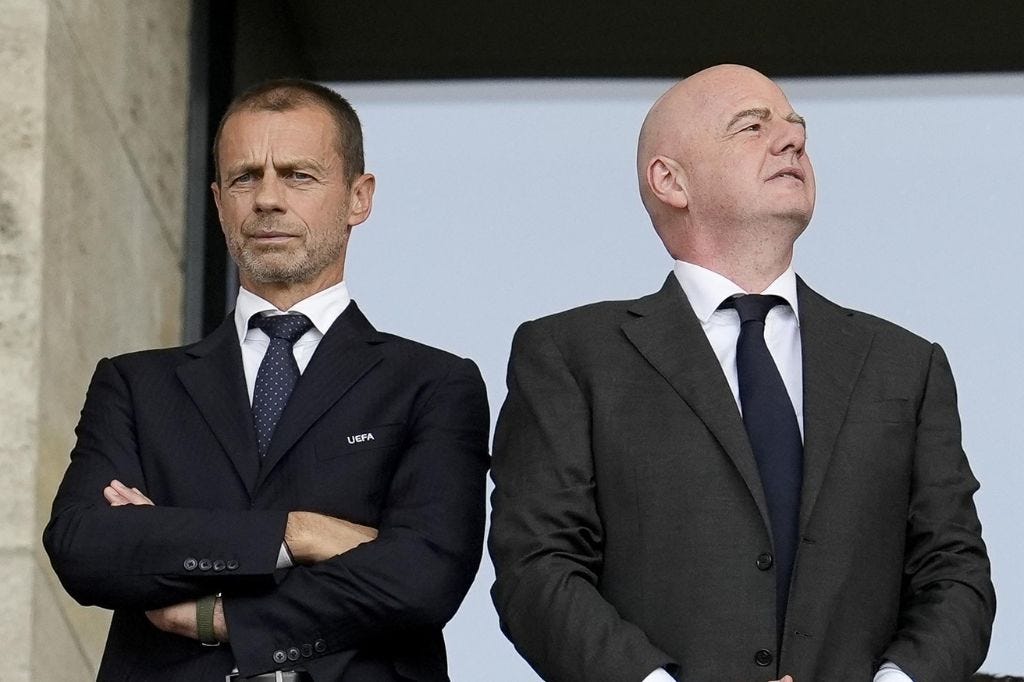
Aleksander Ceferin is right to be alarmed by FIFA President Gianni Infantino’s lust for power, private capital and football’s further commercialisation. But when the UEFA president insists that “football is not for sale”, he is speaking as the head of an organisation that has spent decades auctioning off European football’s competitive soul to the highest bidder.
Ceferin’s broadside at Infantino - wrapped in warnings about “emperors”, custodianship and the danger of letting money dictate the game’s future - is politically useful, rhetorically sharp and morally incomplete. FIFA deserves scrutiny. Yet UEFA cannot plausibly present itself as football’s last line of defence against monetisation while its flagship competitions increasingly exist to protect the revenues, places and status of clubs from Europe’s biggest television markets.
The emperor has company
Ceferin’s remarks came amid UEFA’s dispute with FIFA over plans for a commercial subsidiary that could have managed major FIFA competitions and potentially opened the door to private investment of the World Cup. He argued that football’s leaders are “custodians, not owners”, that nobody has the right to sell its future, and that the sport has “no need for emperors”. It was an unmistakable attack on Infantino and his centralising, expansionist vision for the global game.
On the narrow question, Ceferin has a point. Football should not be treated as the personal asset of whichever president happens to be in office. Nor should the World Cup, the Club World Cup or national teams be used as chips in a private-equity transaction, designed to create another layer of corporate value for investors who will never stand on a terrace, travel to a qualifying match or care what happens to a club once the commercial cycle has moved on.
But it takes a remarkable degree of institutional self-belief for UEFA to make that case without acknowledging its own record. European football has not been preserved from the market by UEFA. It has been reorganised for the market by UEFA.
The organisation may not have sold a stake in its competitions to an outside investor, but it has long sold access, prestige, calendar space, broadcast inventory and sporting fairness in exchange for ever-larger television and commercial deals. The beneficiaries have not been European football in its fullest sense - the 55 member associations, their champions, their communities and the leagues whose clubs provide its cultural depth. The chief beneficiaries have been UEFA itself and the already wealthy clubs - particularly those in England, Spain, Germany, Italy and France - whose presence maximises the value of the product.
There is an important distinction between funding football and turning football into a financial product. UEFA likes to blur it. The problem is not that European competition generates money. Professional football needs money. The problem is who gets it, what sporting principles are bent to generate more of it, and whether the system still offers a meaningful route from domestic success to continental opportunity. On those tests, UEFA’s defence becomes much less convincing.
From champions to customers
The European Cup was once beautifully simple. Win your domestic league and you earned the right to call yourself a European champion. It was imperfect, often harsh, and its straight knockout format could eliminate a giant club in September. But it was honest - actual champions playing for the club championship of Europe.
It was also genuinely continental. The champions of Scotland, Sweden, Romania, Yugoslavia, Portugal and elsewhere were not decorative guests imported for atmosphere. They belonged in the competition because they had won their nation’s premier league title.
When the Champions League began in 1992-93, there was still one club per country. Rangers, as Scottish champions, went unbeaten and came within a point of reaching the final; IFK Gothenburg, with semi-professional players, finished second in their group. That is not nostalgia for the sake of nostalgia. It is evidence of a competition where sporting success in smaller countries could still translate into a serious continental platform.
Then came the commercial infestation. UEFA recognised that the richest broadcasters wanted more guaranteed involvement from the clubs in the largest markets. The old format did not guarantee this - a Milan, Barcelona, Manchester United or Real Madrid could lose early in the competition, depriving television partners of the glamour fixtures they had bought. For football romantics, that uncertainty was the point. For the people packaging the competition and investing in it, it was a business risk. So the rules changed.
In 1994-95, the champions of the major markets were placed directly into an expanded group stage, while the champions of 22 other national associations were denied entry to it and pushed into UEFA qualifying rounds. In 1997, runners-up from the highest-ranked leagues were admitted. In 1999-2000, the biggest three leagues could send four teams. By 2018-19, four clubs from each of England, Spain, Germany and Italy went straight into the group stage.
This was not an accident of footballing evolution. It was a strategic answer to commercial pressure. UEFA’s own former general secretary, Gerhard Aigner, acknowledged that UEFA made a mistake by giving the biggest clubs extra places, because it reduced the chance for champions from other countries to enter the competition. He put it bluntly, when two clubs from the major nations had to qualify, other countries had “a real chance”; once four places were handed to the richest leagues, “the door is too small for them to enter”.
That should be the heart of the argument. The Champions League is no longer primarily a competition for champions. It is an elite league-phase tournament in which finishing fourth and sometimes fifth in a domestic league can be rewarded with access to Europe’s greatest prize. Nobody should be expected to accept that this is fundamentally about sporting merit.
A side that has not won its league, perhaps has not even finished on the podium, can enter the Champions League because it represents a more lucrative market, carries a globally recognised badge, or helps ensure that a broadcaster gets enough premium fixtures to showcase. Meanwhile, the champions of a smaller nation may face multiple qualifying rounds in July and August merely to reach the same table. That is not a level playing field. It is a hierarchy with a footballing veneer.
The gravy train has tracks
The modern Champions League format makes UEFA’s priorities even clearer. The 36-team league phase brought more fixtures, more broadcast slots and more opportunities to sell matches between the continent’s biggest brands. UEFA says the system creates more high-profile games and greater diversity. The commercial translation is simpler - more inventory, more certainty and more money.
The effect is visible in the allocation of places. Europe’s five leading leagues occupy 22 of the 36 Champions League league-phase slots, and only one of their clubs needed to navigate qualifying to reach that stage in the first season of the new format. Just 16 of UEFA’s 55 member associations were represented.
That is the reality behind the polished language of “European football”. Europe is not simply England, Spain, Germany, Italy and France, with the rest invited to make up the numbers. It includes Scotland, Ireland, Wales, Norway, Sweden, Finland, Denmark, Iceland, Poland, Slovakia, Hungary, Croatia, Serbia, Slovenia, Greece, Cyprus, Romania, Bulgaria, Albania, Georgia, Armenia and dozens of other football nations.
Their champions do not lack passion, history or competitive legitimacy. They lack the television-market value that UEFA and its major clubs prize most.
The disparity is not only about entry. It is about the self-reinforcing financial cycle that follows. Champions League participation brings significant prize money, broadcast income, matchday revenue, sponsorship attraction, player recruitment power, and international visibility. Those benefits allow qualifying clubs to strengthen their squads, dominate their domestic leagues and qualify again. At the top end, the biggest clubs collect more of everything - coefficient money, market-pool value, sponsorship leverage and access to the most valuable fixtures.
The more the big clubs qualify, the richer they become. The richer they become, the more likely they are to qualify. UEFA then points to their dominance as proof that they deserve the places and money in the first place. It is circular economics dressed up as sporting merit.
The current distribution system has historically channelled significant money through market-pool and coefficient mechanisms. That means rewards are linked not just to what a club achieves in that season but to the size of its domestic television market and its accumulated European pedigree. An established giant from a major league can therefore enjoy advantages that have little to do with whether it was actually the best team in its country that year. And, as ever, the smaller club pays the price.
Football Benchmark’s analysis offers a more nuanced picture than the simple claim that every UEFA reform shuts out smaller nations. The number of clubs from 45 small and medium markets appearing across UEFA competitions has risen, from an average of 24 per season before the 2009-10 reforms to 53 in 2024-25. But the increase has been concentrated overwhelmingly in the Conference League. Representation in the Champions League and Europa League has largely stagnated, while breakthroughs in the Champions League knockout rounds have become rare. That is the trick UEFA has perfected, expand the pyramid at the base while fortifying the penthouse.
The Conference League has provided worthwhile European nights and genuine opportunities. Olympiacos winning it in 2024 mattered. So did deep runs by Basel, Djurgården, Rangers and others. But it is not the same as access to the Champions League’s wealth, prestige and global exposure. Offering smaller nations a third-tier continental competition while reserving the flagship competition for the wealthiest leagues is not equality of opportunity. It is managed exclusion.
The Super League defence
UEFA’s standard defence is familiar. It had to make concessions to the major clubs or risk losing them to a breakaway Super League. It had to compromise in order to preserve an open pyramid. It had to feed the beast to stop it devouring the game altogether.
There is truth in that. The threat from the self-appointed superclubs is real, and UEFA deserves credit for opposing the 2021 European Super League proposal. That project was a brazen attempt by a closed group of owners to secure permanent access to wealth regardless of performance. It was contemptuous of domestic leagues, supporters and the basic idea that football should be earned on the pitch.
But UEFA’s opposition to the Super League cannot erase the uncomfortable fact that the Champions League has moved steadily in the same direction - just more slowly, with better branding and a famous anthem.
The Super League’s original sin was not merely greed. Football has always had rich clubs and commercial interests. Its sin was to reduce the risk of failure for the elite and to protect their income from the consequences of poor performance. UEFA has repeatedly done a softer version of precisely that.
The more places given to the major leagues, the more safety nets created for high-coefficient clubs, and the more revenue weighted toward established names and large TV markets, the less meaningful sporting jeopardy becomes. The club that finishes fourth in England does not need protection from the consequences of failing to win its league. It needs to live with those consequences, just as a champion from elsewhere is expected to survive rounds of summer qualifying.
The issue is not whether Arsenal, Chelsea, Tottenham, Manchester United, Juventus, Milan, Borussia Dortmund or Barcelona are big clubs. Of course they are. The issue is why their size should entitle them to an easier route into a competition supposedly reserved for champions than the domestic champions of Scotland, Denmark, Norway, Croatia or Serbia.
If UEFA truly believes in open competition, it should start by restoring a serious distinction between champions and non-champions.
Ceferin should look inward
This is why Ceferin’s speech rings hollow. He may be right about Infantino’s hubris. He may be right that football should not be owned by presidents, investors or corporate vehicles. He may even be right to say that money must never decide what football gives up. But money has already decided a great deal under UEFA’s watch.
It decided that broadcasters needed more English, Spanish, Italian and German clubs. It decided that finishing fourth could be almost as valuable if not more valuable than winning a league. It decided that the champions of smaller nations should face obstacle courses while the non-champions of richer leagues receive direct entry. It decided that more fixtures are always better, even as players are stretched, domestic calendars are squeezed and supporters are asked to buy more subscriptions. It decided that European football should increasingly mean the most marketable clubs rather than the full sporting map of Europe.
Ceferin should not merely ask whether FIFA is putting football up for sale. He should ask what UEFA has already sold, who bought it, and who has been left outside the shop.
The answer is not that UEFA is identical to FIFA. It is not. Nor is the answer that commercial success is inherently corrupt. UEFA competitions generate money that can and should support national associations, youth development, grassroots football and the wider game. The point is that UEFA cannot claim the moral high ground while refusing to confront the inequality built into its own flagship product.
There is a better route. Make domestic champions central again. Give more champions from smaller associations a viable, protected path into the Champions League proper. Reduce the automatic privileges enjoyed by non-champions from the biggest leagues. Distribute revenue more meaningfully across the continent. Stop treating coefficients and television markets as a substitute for what happens on the pitch.
That would not end European football’s financial inequality overnight. The Premier League’s wealth, in particular, is a structural force UEFA cannot simply legislate away. English top-flight clubs have a broadcast income and commercial scale that dwarf much of the continent, and even clubs outside its established elite can now exert financial power over traditional European names.
But UEFA does control the design of its own competitions. It controls access. It controls revenue distribution. It controls whether the European Cup remains, in spirit as well as branding, a competition where champions matter most.
Ceferin is entitled to point at Infantino’s empire-building. He is not entitled to pretend that UEFA has not built its own version of a gated estate around the Champions League.
Football is not for sale? It already has a price tag. UEFA just prefers to call it a broadcast package.
Totally agree Andy. It's in the title. Champions League. To invite a team straight into the group stages after finishing 4th or 5th or 6th in their league devalues the whole tournament and questions its integrity.
Why not rename it "The Fill Your Boots Trophy"
All shameless greedy clubs welcome.
HH
My views entirely Andy, if you win your league you should automatically gain admission to the Champions League end of story. If the big five leagues' clubs that finish second to fifth are as good as UEFA thinks then they should still get through the qualifying rounds easily anyway. As you rightly say it's made a mockery of the title "Champions League" if teams who are, to use horse racing parlance, are placed, then they should be doing all the qualifying. Again as you rightly say how can other teams hope to compete in the latter stages of the biggest competition when the majority of the money stays inside the big five leagues. Where's the sporting integrity in any of this that non champions can win a trophy that's supposed to be made up of actual champions, it's farcical and the whole integrity of the format and competition itself loses any credibility it had and the only way to gain credibility back is to revert back to the original format.