

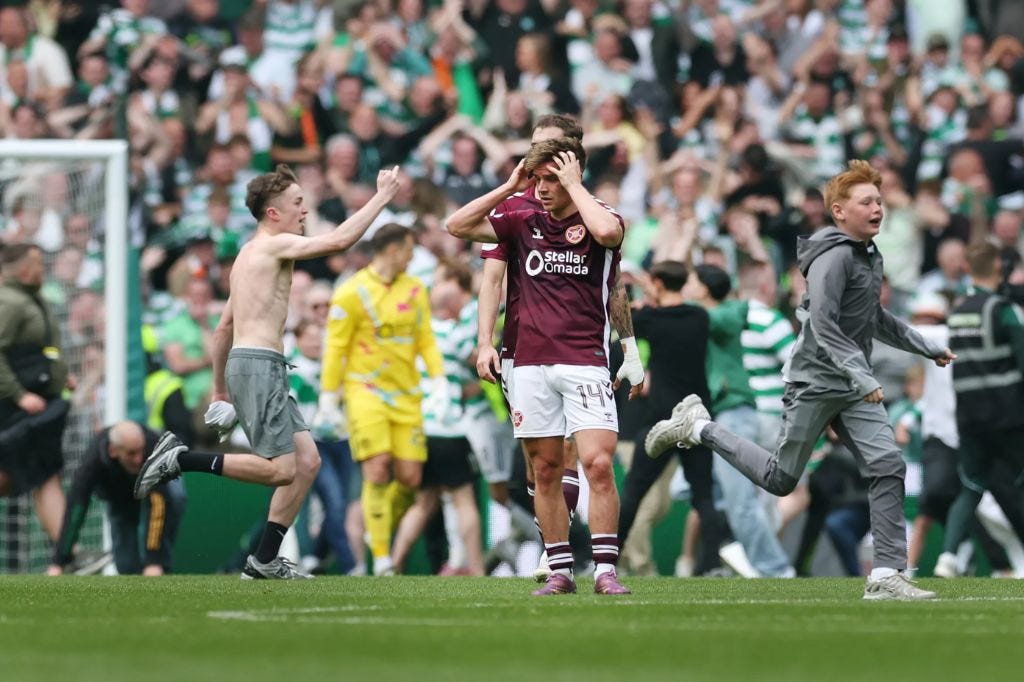
For weeks, a narrative has hung over Celtic’s title-winning day like a bad smell. It has been repeated, embellished, and weaponised by pundits, executives, opposition fans, and compliant sections of the Scottish media.
Hearts players were “assaulted.”
Except, as it turns out, they weren’t.
Hearts midfielder Cammy Devlin has now said it plainly. Calmly. Without agenda. Without theatrics. Without the need to spin a grievance into something it never was.
“None of the players got hurt.”
And just like that, the entire house of cards collapses.
Because Devlin was there. On the pitch. In the chaos. In the moment that so many others have since tried to distort. He is not relying on second-hand accounts, slow-motion replays, still images, or the fevered imagination of two-bit pundits. He lived it.
And he has told the truth.
The same truth that was conspicuously absent when Hearts co-owner Tony Bloom rushed to a Talksport interview to claim that “one or two” Hearts players had been assaulted. The same truth ignored by Pat Nevin and Pat Bonner, who spoke with unwarranted certainty about assaults they claimed to have witnessed but failed to back up with verification. The same truth buried beneath a pile of headlines that prioritised outrage over evidence.
Let’s be absolutely clear, the pitch invasion should not have happened. Devlin himself called it “horrible” and said it “wasn’t nice.” That is a reasonable, grounded reaction. It is the response of a professional who understands both the emotional intensity of football and the standards the game should uphold.
But “not nice” is not the same as “assault.” Discomfort is not violence. Disorder is not injury. And in this case, there were no injuries. No police complaints. No formal reports. No evidence.
Nothing.
Yet the allegation of “assaults” was allowed to run unchecked, amplified by voices that should know better.
Tony Bloom, a man whose words carry weight as Hearts co-owner, did not hedge his claims. He did not say “it looked concerning” or “we are seeking clarity.” He stated, unequivocally, that players were assaulted. That they were in danger. Those are serious accusations. They demand serious proof. None was ever provided. No follow-up. No clarification. No retraction. Just silence. And in that silence, the damage was done.
Because once a claim like that enters the bloodstream of Scottish football discourse, it does not simply disappear. It lingers. It shapes perception. It reinforces existing biases about Celtic supporters and their behaviour. It becomes, in the minds of many, accepted fact.
That is how misinformation works. Not through careful argument, but through repetition.
Pat Nevin and Pat Bonner played their part in that process. Both men spoke claiming they had witnessed the assaults. Both contributed to the sense that something far more sinister had occurred than what was actually visible.
But what did they actually see? What evidence did they present? What incidents did they point to that met the threshold of “assault”? Again, nothing.
It was punditry at its worst - speculative, emotive, and utterly detached from accountability.
And the rest of the Scottish mainstream media? They followed suit. Headlines were written. Angles were chosen. Narratives were constructed. The word “assault” appeared with alarming ease, without qualification, without verification, and without challenge.
There was no collective pause to ask the most basic journalistic question - where is the proof? Instead, the story was too convenient to resist. Celtic fans, celebrating a title, spilling onto the pitch. It fits a familiar trope. It feeds into long-standing caricatures. It generates clicks, outrage, and engagement. And so it was allowed to run.
Even as the days passed. Even as no complaints were lodged with Police Scotland. Even as no player came forward to describe being attacked. Even as the silence grew louder.
That is what makes Devlin’s comments so significant. They cut through all of it. He did not deny the unpleasantness of the situation. He did not pretend the pitch invasion was acceptable. But he drew a clear line between what happened and what was later claimed to have happened.
“No one got hurt.”
It is a simple sentence. But in the context of the past few weeks, it is devastating. Because it exposes the exaggeration. The inflation. The reckless use of language that turned a moment of disorder into something far more serious in the public imagination.
It also raises an uncomfortable question for Hearts. What happens now? If you are Tony Bloom, how do you reconcile your earlier statements with the words of your own player? Do you stand by your claim? Do you provide evidence? Or do you quietly hope the story disappears?
If you are within the Hearts dressing room, how do you respond to a teammate who has effectively contradicted the club’s public stance? Devlin, notably, is out of contract. He is not bound by the same constraints as others. He has spoken freely. And in doing so, he may have said what others could not.
There is also the small matter of Craig Gordon’s comments in the aftermath of the title race. Talk of injustice. Of what might have been. Of a sense that Hearts had somehow been wronged.
It all feeds into a broader narrative of grievance. But grievance without substance is just noise. And Devlin’s intervention cuts through that noise with refreshing clarity.
This is not about defending pitch invasions. It is not about pretending that everything was fine. It wasn’t. The scenes were chaotic. The timing was premature. The optics were poor. But none of that justifies inventing or exaggerating claims of violence. Because once you cross that line, you are no longer describing events. You are distorting them. And that distortion has consequences.
It damages reputations. It fuels division. It entrenches mistrust between clubs, supporters, and the media. It creates a version of reality that is harder to challenge the longer it goes uncorrected.
Which is why accountability matters.
The pundits who spoke out of turn should be asked to explain themselves. The outlets that ran with unverified claims should revisit their coverage. Corrections, clarifications, and apologies are not signs of weakness. They are the foundation of credibility.
And if those do not come voluntarily, then they should be demanded from them.
Because if this episode proves anything, it is that narratives in Scottish football are too often shaped by assumption rather than evidence. By bias rather than balance. By the loudest voices rather than the most accurate ones.
Celtic, as a club, will likely say little. That is their way. They rarely engage in media battles, even when the coverage strays into the unfair or the absurd when it comes to the fans. But the supporters have every right to challenge what they have seen unfold. Not with conspiracy or counter-myths, but with facts. With the words of a player who was actually there. With the absence of complaints, reports, or injuries. With the simple, undeniable truth that the most serious allegations made in the aftermath of that game have not been substantiated in any meaningful way.
Cammy Devlin did not set out to start a media storm. If anything, his comments were measured, even restrained. He acknowledged the disappointment of the result. The unpleasantness of the scenes. The emotional weight of a season that slipped away.
But in telling the truth, he has forced a reckoning. Because the story that followed Celtic’s title win was never just about football. It became a test of how quickly claims can be made, how widely they can spread, and how rarely they are challenged.
Now, finally, it has been challenged. Not by a fan. Not by a club statement. Not by social media speculation. But by a Hearts player. And that should matter. It should matter to those who reported the story. To those who commented on it. To those who believed it.
Most of all, it should matter to those who were so quick to turn allegation into accepted fact. The lie lasted weeks. The truth took one sentence.
I wonder if Devlin’s comments will receive the same press coverage as the lies about the assaults did?
Bold, brave and honest comments by Cammy Devlin. I've heard Cammy is up for transfer, I wonder if he is angling for a move to Celtic ?.
Nevin and Bonnar are both media soup takers.
Manufactured grievance was also a very convenient cop-out/ figleaf to distract from the collective and monumental bottle crash of Hearts leadership, management and players.
Certain pundits knew exactly what they were unleashing- the lie went viral before the truth even had a chance to get it's trousers on- only made worse by our Board's baffling indifference and failure to properly hold this to account.