

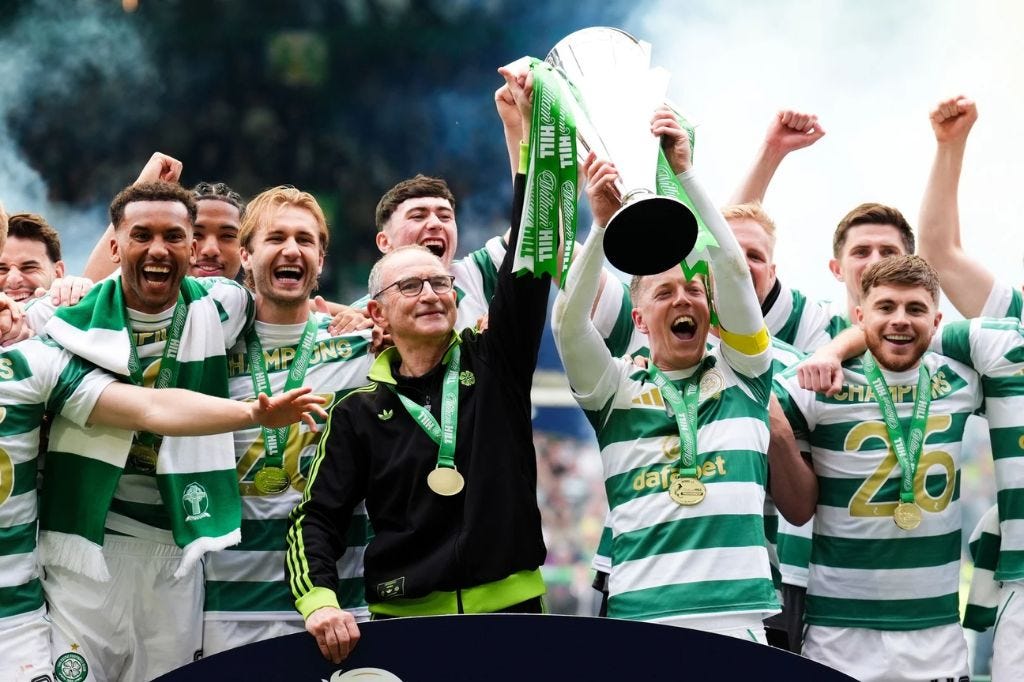
Celtic did not just win the title on the final day; they stole it back with a brutal efficiency that left Hearts sprawling on the turf in tears and their season in tatters. For a club that spent most of the campaign at the summit, this was not just a collapse, it was another historic bottle job for the Tynecastle side, and Celtic’s fifth league title in a row will be remembered as much for Hearts cracking under the pressure as for Celtic’s extraordinary comeback.
Hearts needed only a draw at Celtic Park to clinch their first league title in 66 years, after leading the table since September. Instead, they were dragged into the kind of pressure cooker that decides champions, and when the heat was turned up ahead of the final day, Derek McInnes’ side simply could not hold their nerve and buckled up into the fetal position.
Celtic were not perfect, but they were ruthless when it mattered. They came from behind to win 3-1, with Daizen Maeda and Callum Osmand delivering the late goals that tore the trophy away from Hearts’ sweaty clammy hands at the very last moment. The final kick of the game made the point brutally clear - champions do not beg for help, they do not whine, they do not spit the dummy, they take.
Hearts’ approach looked like a team trying to smother the occasion rather than win it, and that is precisely where the danger lay. The time-wasting, the stoppages, the rolling over faking injuries, the delay tactics, the constant attempt to drag Celtic into a grim, nervous trench battle all felt designed to protect a draw rather than seize a title with a victory. That may work on an ordinary afternoon, but against a Celtic side with 60000 fans behind them and the clock turning into an ally, it was a suicidal game plan from Derek McInnes.
Hearts started playing for the point pretty much as soon as the second half kicked off, making a substitution with seconds of the restart to try to knock Celtic out of their rhythm. They invited Celtic to take the game to them and they duly delivered, and with nerves kicking in on and off the field it is this point in time where title-winning sides often find their edge. The late push from Hearts, including the goalkeeper going up for a set piece, only made the eventual damage worse, because it left the door wide open for Celtic to finish the job on the break and send the tens of thousands of Celtic fans in the stadium, and hundreds of thousands worldwide delirious - not to mention the Hibernian fans who had been biting their fingernails down to their knuckles throughout.
Celtic’s Chaotic Season
This title will stand apart because of everything Celtic endured before they reached the final day. Brendan Rodgers quit, Martin O’Neill returned in interim charge, Wilfried Nancy arrived and was then gone 33 days later, and O’Neill came back again to shepherd the team across the finish line. It was a season of upheaval, noise and constant turbulence, the sort of internal mess that usually ends in failure, not trophies.
And yet Celtic somehow strung together seven straight league wins to close it out, including a 3-1 demolition of Rangers that effectively ended the Ibrox side’s title hopes, and a last-gasp penalty against Motherwell that kept the title run alive. That sort of finish is not the product of serenity or neat planning; it is the product of a club deciding, at the point of maximum disorder, that the title was still theirs for the taking.
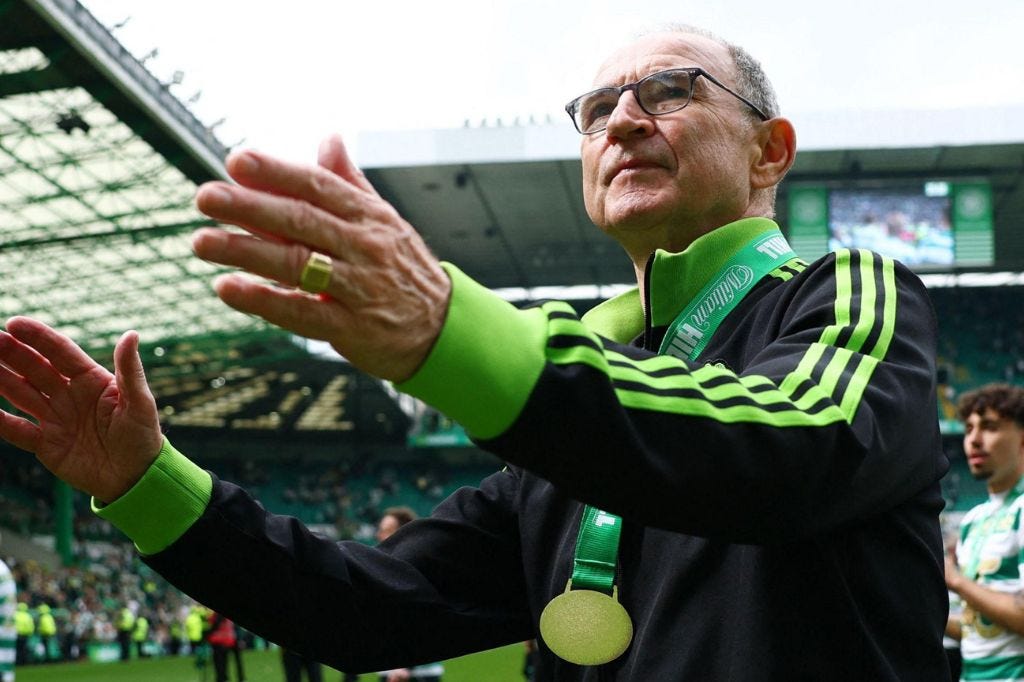
It is almost comical that Martin O’Neill, mocked by rivals and written off by plenty of hacks as a ‘pensioner in a trackie’, has ended up writing one of the most unlikely title wins in Celtic history. The man who was dismissed as a nostalgic or a desperate appointment has steadied a side that looked broken in January and turned them into a team capable of winning when the season was at its most poisonous.
That does not mean Celtic suddenly became a well-oiled machine. It means O’Neill understood exactly what was required from a team in distress - simplicity, belief, and enough tactical nous to stop the collapse becoming permanent. In a season full of chaos, he was the nearest thing Celtic had to a constant, and that alone deserves its own chapter in the story of this title.
The Boardroom Rot
This was never just about what happened on the pitch. The club AGM descended into disorder, the board walked out amid protests, Peter Lawwell departed claiming threats and abuse, merchandise boycotts gathered pace, and Dermot Desmond’s son talked down to supporters in the way only an insulated nepo baby elitist can manage. It was the kind of boardroom toxicity that makes a football club feel far larger than its football problem, because every bit of unrest spills straight into the team.
That the supporters still found a way to drive the team forward to the title should embarrass everyone who helped create the mess. Celtic’s hierarchy spent all season long acting as if the noise around them was the problem, when in reality the noise was the warning. The fans were right to protest, right to boycott, and right to call out a structure that too often behaves as though the club belongs to them rather than the people who live and breathe it.
Hearts blew it
There is no sugar-coating this for Hearts, just as they did in 1986, they had the title in sight and let it slip through their hands in the ugliest possible manner. A club top for so long, a club with all the momentum, a club that had every incentive to play the occasion with courage, chose caution and then paid for it in the harshest way possible.
That is the pain of bottling a title race. It is not just losing on the day, it is spending months as the benchmark and then discovering that the one afternoon that mattered most was the one you could not handle the pressure. The departure of the Hearts team on buses following the full time whistle and in the aftermath of a pitch invasion, spared McInnes and his charges the question marks around the game plan, why they looked like a deer in headlights late on, why their captain Lawrence Shankland resorted to bully boy tactics after Celtic went 2-1 up and escaped a sending off for kicking out at and grabbing Daizen Maeda by the throat, and why they ultimately struggled against a Celtic side that is arguably the worst in a generation.
What the title means
For Celtic, this is a fifth consecutive championship and a 56th top-flight title, won in a season. It is one of the most hard-earned titles in the club’s recent history, not because the football was always dazzling, but because everything around it seemed determined to drag them under and stand in their way.
That is why the scale of the achievement matters. A team with fractured leadership, ugly boardroom politics, awful windows in summer and January, injuries to key players, fan unrest, bans and internal upheaval somehow found enough juice in the tank to finish on a seven-game winning run and snatch the league at the death. That is not normal title-winning behaviour, that is survival turning into triumph.
So yes, Hearts bottled it. Top since September, had the league within their clutches, and when the moment came, they blew it, and Celtic did what champions do - they punished hesitation, tore the script up, and strutted off with the trophy.
But the season is not finished yet. Celtic still have the Scottish Cup Final to come against Dunfermline, a proper teacher-versus-pupil clash as Martin O’Neill goes toe-to-toe with Neil Lennon, the former Celtic captain and manager. It is a fitting final act to a mad, chaotic season, and one more chance for Celtic to put silverware on the table before the summer arrives. Or lose to the Pars and consign rivals Rangers to the Conference League - surely that wouldn’t happen? Wink wink nudge nudge.
Because once the cup final is done, all eyes will turn to the World Cup in America, while Celtic will be left with something far more important than tournament chatter - a monumental rebuild. If this season has taught us anything, it is that another year like this cannot be allowed to happen. The club needs proper planning, proper recruitment, and proper leadership if they are to avoid turning next season into another exercise in damage limitation.
Regarding the huns' European participation, I'm not sure if I'd care should Dunfermline win, but silverware is our default position, so I'll be cheering them on but should we not win, it'll be some silver lining.
It was never in doubt, Andy.
Nudge, Nudge, Wink, Wink.