

The Independent Review into the events of 8 March 2026 at Ibrox Stadium runs to 37 pages of detailed analysis, recommendations, and observations. It is, in many respects, a thorough piece of work. But like all documents produced by established institutions and corporate executives, it carries within it the fingerprints of the very institutional biases it purports to transcend.
The review’s central framing - that both sets of supporters were equally culpable in the disorder - is convenient, predictable, and fundamentally dishonest. It allows the authorities to wash their hands of the uncomfortable truth that while Celtic fans engaged in a jubilant - albeit illegal - pitch invasion, Rangers fans engaged in something far darker, a coordinated, violent attempt to attack celebrating Celtic fans, and anyone who stood in their way.
The Ticket Breaches: A Failure of Security, Not a Moral Equivalence
Let us address head-on the behaviour of the Celtic supporters who breached the security cordon on 8 March. The facts are not in dispute, a significant number of Celtic fans forced their way through the Broomloan Road search lanes, overwhelmed stewards and police, and created dangerous conditions at the point of entry. Some gained unlawful access through Exit Gate 31, where a steward was subsequently arrested for accepting payments and directing supporters to turnstiles and fire exits. The review estimates that 30 to 40 fans entered through this compromised gate, contributing to overcrowding within the Broomloan Stand. The turnstiles were closed for 28 minutes by the Safety Officer in an attempt to regain control, a decision that itself created additional crush risk as fans continued to build up outside.
These actions were inexcusable. They put fellow Celtic supporters at risk of crushing and overcrowding, and they could have prevented legitimate ticket holders from gaining entry to the stadium they had paid to access. Placing stewards and police officers in dangerous positions as well. The individuals who engaged in this behaviour- whether through forcing gates, using forged tickets, or doubling up at turnstiles - bear direct responsibility for their actions. The review’s observation that “supporters without tickets and with forged tickets rushed to the turnstiles and tried to gain entry by doubling-up and forcing Exit gates” is a damning indictment of a minority who prioritised their own desires over the safety of thousands of their fellow Celtic supporters.
But the review’s framing of these events is incomplete. It fails to adequately address the institutional failures that made these breaches possible and more importantly, it uses these breaches to construct a false equivalence between the behaviour of Celtic fans outside the ground and the violent attacks perpetrated by Rangers fans inside it.
The breaches were not merely the result of fan misconduct, they were the foreseeable consequence of operational failures. The review itself acknowledges that “non-compliant supporters surging past police and stewards created real and foreseeable crushing risk.” The word “foreseeable” is crucial. Rangers and Police Scotland knew or should have known that their arrangements were inadequate. The Green Brigade’s likely non-compliance with the club-imposed ban was treated as a planning assumption, not an exception. The review explicitly notes that “the treatment of the likely non-compliance by the Green Brigade with the club-imposed ban on them as a planning assumption by Clubs and Police Scotland rather than an exception indicates a failure in the effectiveness of such bans.”
This is not to excuse the behaviour of the Celtic fans who breached security. They acted illegally and irresponsibly. But their actions must be understood in the context of a security operation that was, by the admission of its own architects, aspirational rather than operational. The failure to anticipate and plan for known risks created the conditions in which breaches became almost inevitable.
And here is where the review’s framing becomes problematic. The breaches by Celtic fans outside the stadium are presented as part of a continuum of misconduct that includes the violent attacks by Rangers fans on the pitch. This is a false equivalence. The Celtic fans who breached security did so to get into the stadium to watch their team play a historic cup tie. Their actions, however reckless, were not motivated by a desire to cause harm. The Rangers fans who ran onto the pitch were motivated by something far darker, a desire to attack, to intimidate, and to reclaim what they perceived as their territory through violence.
The review’s own evidence supports this distinction.
The review’s recommendations on ticketing and security are welcome, but they cannot be allowed to obscure the fundamental point that the behaviour of Celtic fans outside the stadium, however irresponsible, was significantly different from the behaviour of Rangers fans on the pitch after the penalty shoot out. One group created a risk of crushing and overcrowding, the other actively sought to cause harm. One group was poorly managed by a failed security operation; the other was enabled by a club hierarchy that has consistently facilitated its hooligan activities.
The Celtic Incursion: Jubilation, Not Violence
Let us be absolutely clear from the outset, the Celtic supporters who entered the pitch after the penalty shootout victory on 8 March broke the law. They had no legal right to be on the playing surface. Their actions were inexcusable from a regulatory standpoint and it helped to somewhat overshadow the victory against Rangers at their own stadium. They put themselves, their fellow supporters, and stadium staff at risk. These are facts that cannot be disputed.
But context matters. The review itself acknowledges that the Celtic fans “were the first to enter the pitch in jubilation.” This was a spontaneous outpouring of emotion following Celtic winning a cup tie at Ibrox - a moment of significance for the club and its supporters. The celebration was born of joy, not malice.
The sequence of events is telling. Celtic player number 22 [Julian Araujo] ran to the Broomloan Stand and swung on the crossbar to celebrate. Two to three supporters joined from the stand to celebrate. A significant number rapidly followed. The momentum built organically, driven by the emotional release of a brilliant victory.
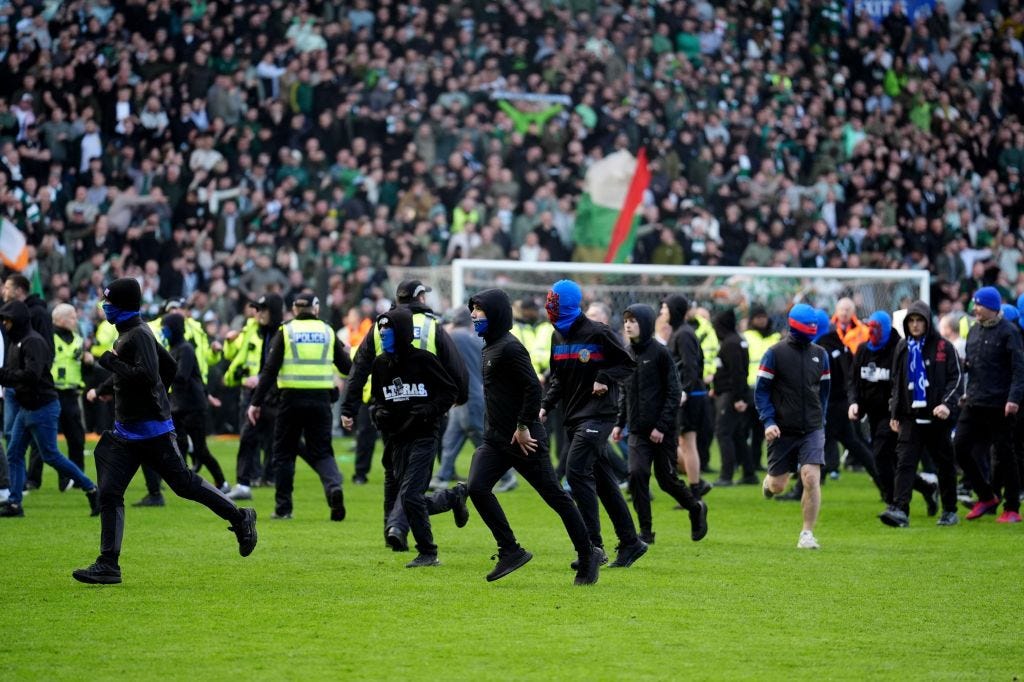
Contrast this with what followed. The review records that “the Union Bears and other home supporters left the Copland Stand for the track and pitch. They ran en masse towards the Celtic supporters to violently confront them.” This was not jubilation. This was a planned, coordinated response driven by fury and a desire to attack celebrating Celtic fans. Pure hooliganism.
The Rangers Response: A Calculated Attack
The Rangers fans who entered the pitch did so with clear intent. They were not celebrating; they were attacking. The review documents that “masked home fans armed with poles and reinforced gloves came within a very small margin of a violent mass confrontation.” These individuals were equipped for violence. The masks and weapons were not spontaneous, they were brought to the stadium with the specific purpose of causing harm.
The violence perpetrated by Rangers fans was not limited to confronting Celtic supporters. The review records that:
A Stand Manager was “confronted by a masked Rangers fan - assumed to be an Ultra group member - and hit in the face and hospitalised.” This individual is receiving “ongoing treatment to the inner ear following a traumatic injury.”
A Celtic staff member was assaulted from the Main Stand Enclosure.
A flare was thrown between the two groups six times, striking a Rangers security operative and the CCTV operator.
A steward was struck by a bottle.
The Deputy Safety Officer was assaulted by a player - note this occurred during the disorder triggered by the Rangers incursion.
This is not a pattern of behaviour that can be equated with a spontaneous celebration. This is organised violence, perpetrated by individuals who came prepared to cause harm.
A Pattern of Targeting Celtic Personnel
The review’s observation that “Celtic staff and players have faced increasing attacks and targeting from Rangers fans over the years” is buried in the fine print, but it deserves far greater emphasis. This is not an isolated incident. It is part of a pattern of behaviour that has been escalating for years.
Celtic players have been subjected to racial abuse, as noted in the review when “J Tavernier (RFC) reports racial abuse from away supporter.” While Tavernier was right to report the abuse he allegedly faced, it is somewhat ironic that at the same time as he reported this to the referee, his own club’s supporters were violenty assaulting Celtic personnel. Yet both sets of fans are treated as equally culpable in the report’s framing.
The targeting of Celtic staff is a recurring theme over the past few years. The review also noted that a Celtic supporter bus was attacked on Helen Street, with a supporter left unconscious in the road requiring emergency hospital treatment. This was not a spontaneous act; it was a targeted attack by Rangers fans on a vehicle clearly identifiable as carrying Celtic supporters.
The Convenient Equivalence: Why Both Sides Are Treated Alike
The review’s treatment of the two Ultra groups is particularly revealing. Both the Green Brigade and the Union Bears are described as operating “like organised crime groups” with “internal hierarchy, coordinated planning, operational security awareness, and the use of intimidation in securing best position.”
This framing is intellectually dishonest and politically convenient. While it is true that both groups exhibit organisational characteristics, their activities and outcomes are fundamentally different.
The Green Brigade, for all their faults, occasional excesses, and front page incidents, have a long-established record of charitable work. They have raised hundreds of thousands of pounds for good causes, including food banks, refugee charities, and community projects. This does not excuse their behaviour overall, but it provides a context that the review conveniently ignores.
The Union Bears, by contrast, have a documented history of criminality that extends far beyond football. The review’s framing fails to acknowledge that several prominent Union Bears members have been convicted of serious crimes, including drug trafficking and violent assault. These are not isolated incidents; they are evidence of a culture of criminality that the Rangers hierarchy has been complicit in facilitating.
The relationship between Rangers Football Club and the Union Bears is not one of passive tolerance; it is one of active facilitation. The club has provided the group with unprecedented access to the stadium, promoted their donation drives through official channels, and turned a blind eye to their activities in exchange for “atmosphere” and the avoidance of fan protests against the board.
This is not speculation. The evidence is well-documented. During a tifo setup ahead of a derby game against Celtic, weapons including hammers and knives were discovered hidden among the Union Bears’ banners in a storage bin. The club’s response? Silence. No investigation, no distancing, no meaningful action.
The former Union Bears leader, Ross McGill, used his position within the group to launch a criminal enterprise involving organised crime and drug dealing before fleeing to Dubai. Another prominent member, Lloyd Cross, was jailed for his part in a £100 million plot to import cocaine. Yet the club continues to facilitate the group’s activities, even as its members engage in violent attacks on opposing fans, staff. and Rangers’ own stadium staff.
This is not a failure of oversight; it is a choice. The Rangers hierarchy has decided that the benefits of keeping the Union Bears onside outweigh the risks of their criminality. They have entered into what can only be described as a Faustian pact, trading the safety and reputation of their club for a quiet life.
The Celtic Board: A Tougher Stance
In contrast, Celtic’s board has taken a significantly tougher line against the Green Brigade. The review notes that Celtic imposed a banning order on approximately 200 identified members of the Green Brigade for the period November 2025 to April 2026, preventing access to Celtic Park and away match tickets. This is not the action of a club that is complicit in the activities of its Ultra group; it is the action of a club that is targeting the group head-on - whether it is right or wrong in the eyes of the Celtic support.
The review acknowledges that Celtic “openly discussed the group’s intended drums and seating locations” at pre-operational meetings, but this is not evidence of complicity - it is evidence of responsible planning. Celtic were upfront about the challenges posed by their Ultra group and sought to manage them within the framework available.
The contrast with Rangers could not be starker. While Celtic has taken meaningful action against its Ultra group, Rangers has actively facilitated the Union Bears’ activities, providing them with legitimacy and support even as their members engaged in criminality.
The Convenient Narrative: Why the Report Fails
The review’s failure to adequately differentiate between the two sets of supporters is not accidental. It reflects a broader pattern in Scottish football governance - the tendency to treat both sides of the Glasgow divide as equally culpable, regardless of the facts. This approach is politically convenient, it allows the authorities to avoid difficult questions about the differing behaviours of the two fan bases and the respective responses of the two clubs.
But it is also fundamentally dishonest. The evidence in the review itself contradicts the equivalence it seeks to establish. The Celtic fans who entered the pitch did so in jubilation. The Rangers fans who entered the pitch did so in anger, armed with weapons, intent on causing harm. These are not equivalent acts.
A Pattern of Violence
The violence directed at Celtic supporters and personnel is not an isolated incident. It is part of a pattern that has been escalating for years. Celtic players have been subjected to racial abuse, physical attacks, and threats. Celtic supporters have been attacked on the streets, their buses targeted, their pubs vandalised.
The review’s treatment of this pattern is inadequate. It acknowledges the targeting of Celtic personnel but fails to connect the dots, to recognise that the violence on 8 March was not spontaneous but part of a broader culture of hostility directed at Celtic and its supporters.
This culture is facilitated by the Rangers hierarchy’s complicity in the Union Bears’ activities. By providing the group with legitimacy and support, the club has created an environment in which criminality and violence are ignored, even tolerated. The Union Bears are not a symptom of the problem; they are the problem, and the Rangers hierarchy is actively facilitating their criminality.
A Missed Opportunity
The Independent Review of the events of 8 March was an opportunity for Scottish football to confront uncomfortable truths. Instead, it has produced a document that, while detailed in its analysis of operational failures, falls short in its treatment of the fundamental issue - the differential behaviour of the two sets of supporters and the complicity of the Rangers hierarchy in facilitating the Union Bears’ hooliganism.
The review’s treatment of the two Ultra groups as equivalent is intellectually dishonest. The Green Brigade’s charitable work, however inconvenient to the narrative, demonstrates a fundamental difference in culture and purpose. The Union Bears’ criminality, demonstrates a culture of violence that extends far beyond football.
By treating both sides as equally culpable, the review has done a disservice to the thousands of law-abiding Celtic supporters who were subjected to violence and intimidation on 8 March. It has also given comfort to the Rangers hierarchy, allowing them to continue their Faustian pact with the Union Bears without meaningful accountability.
The blood that will inevitably be spilled in future incidents - whether on the pitch, on the streets, or in the stands - will not just be on the hands of the thugs. It will be on the hands of the men in suits who chose complicity over accountability, convenience over courage, and silence over truth.
The review’s final observation that “action is greater than words” is correct. But the action required is not just operational reform - it is a fundamental reckoning with the culture of violence that has been allowed to flourish at Ibrox, facilitated by a hierarchy that has prioritised a quiet life over the safety of everyone connected to Scottish football.
This is the second article of three in the series reporting on the Scottish FA Independent Review.