This is a thought experiment only. It explores one hypothetical route by which Celtic supporters could eventually move beyond the current PLC structure, Dermot Desmond’s influential shareholding and a board many fans believe lacks accountability and transparency.
The aim is not to pretend that removing the present power structure would be simple or cost-free, but to ask whether a self-sustaining club of Celtic’s scale could be owned, governed and protected by the people who fund it year after year - the supporters.

Introduction
Celtic could move from its AIM-listed PLC structure to a 100% member-owned socio club without relying on a new millionaire owner, but only through a negotiated, phased and professionally financed transition. The club’s existing ability to generate income from tickets, commercial activity, retail, broadcasting, European competition and player trading means the objective would not be to find someone to bankroll the football operation; it would be to transfer control from shareholders to the people who already sustain the club - the supporters themselves.
The central principle would be simple in theory - Celtic should be owned by its members, run by qualified professionals, and governed in the interests of the club’s long-term future rather than the preferences of any individual shareholder or private investor.
The ownership change
Celtic are currently a public limited company with multiple classes of shares traded on AIM, the London Stock Exchange’s growth market. That means control ultimately rests with voting share capital, not with season-ticket holders or the wider support. The club itself acknowledges that it has three listed share classes.
Leaving AIM is possible, but it is only one part of the task. Under AIM Rule 41, cancelling a company’s market admission requires at least 75% of votes cast at a shareholder general meeting, plus notification to shareholders and the London Stock Exchange at least 20 clear business days before cancellation. Delisting Celtic would therefore not automatically make the club fan-owned. It would simply remove the public-market listing. The meaningful transformation would be the transfer of voting control and the rewriting of the club’s constitution.
A phased route
Phase 1: Create Celtic Members Trust
A new independent body would be formed before any takeover bid or delisting process. It would need:
An elected interim council.
Proper FCA/company/charity and football-governance advice.
Published constitution, audited accounts and membership register.
Strict one-member-one-vote rules.
A legal commitment that no director, trustee or outside financier can convert support into personal control.
A formal commitment to keep Celtic Park, club identity and core assets under member protection.
The trust would become the democratic vehicle through which supporters organise, build capital and negotiate.
There is already a foundation for collective shareholder action. The Celtic Trust’s “Drive for Five” initiative says roughly 27,700 individual shareholders collectively own about 17.5% of Celtic shares, while a 5% voting bloc can secure the right to call an extraordinary general meeting. That is not fan ownership, but it demonstrates that a significant base of ordinary supporters already exists within the PLC’s shareholder structure.
Phase 2: Secure a controlling stake
The trust’s initial ambition should be a protected 25% plus one share block, then 51% control, before a full 100% conversion. This is much more realistic than pretending that tens of millions can be raised overnight.
The acquisition vehicle could be funded through:
Membership income.
Voluntary community shares or supporter bonds.
Long-term pledges from the diaspora.
Legacy giving.
Ethical finance secured against predictable membership income - not Celtic’s operating assets.
Donations or underwriting from wealthy supporters, but without extra voting rights or personal ownership.
Negotiated sale, conversion or donation of major shareholdings.
A crucial line must not be crossed, the club should not borrow heavily to buy itself. Celtic Park, annual season-ticket income and future European earnings should not be placed at risk in order to remove private owners. The buyout vehicle must carry its own risk, and payments must remain affordable even in seasons without Champions League income.
Phase 3: Delist and restructure
Once a member vehicle has secured sufficient shareholder backing, the club could pursue AIM cancellation through the 75% vote required under the AIM rules.
The restructuring would then involve:
Purchasing or converting remaining shares through an agreed scheme.
Re-registering the operating club under an appropriate private-company/co-operative/community-benefit structure, subject to detailed legal advice.
Cancelling the economic and voting privileges attached to historical share ownership in return for fair consideration.
Vesting control in the Celtic Members Trust or an equivalent member-owned parent body.
Introducing a constitutional “golden share” held by the members to protect the club’s identity and essential assets.
The goal is not merely an unlisted Celtic. It is a Celtic in which no one can buy 30%, 50% or 75% of the club and dictate its future.
How the club would be governed
Celtic should borrow the essential democratic principle of Barcelona’s socio system without copying every part of Barcelona’s structure. The model should be designed for Celtic’s finances, law, geography and global supporter base.
The constitutional rule
Every qualifying socio receives one vote.
Membership cannot be bought, sold, gifted, inherited, transferred or accumulated.
A wealthy supporter who contributes £1 million receives the same voting power as a supporter paying the standard socio fee.
No dividends are paid to socios.
No socio can sell their membership for personal gain.
Operating surpluses are retained and reinvested in football, facilities, supporter services, academy development, women’s football, community activity and prudent reserves.
Major constitutional decisions require a supermajority of socio members.
The club’s name, colours, crest, Celtic Park and home location are protected assets requiring an exceptional majority for any change.
This does not mean Celtic must legally become a charitable non-profit in the narrow technical sense. A football club needs to trade, employ people, buy and sell players, pay tax and make operating surpluses. The more accurate description is not-for-private-distribution. Celtic can generate profit, but no individual owner extracts it as dividends or capital gains. The surplus remains inside the club.
President and board
The President would be elected by socios every six years, on a fixed term. That mirrors the broad political rhythm of FC Barcelona, whose presidential cycle is based on six-year terms. The President would lead the elected club board and present a manifesto before election.
To avoid turning Celtic into a personality contest, the system should require tickets rather than lone candidates:
A presidential candidate stands with a proposed board slate.
Each ticket publishes a six-year strategic plan.
Each plan includes football governance, stadium development, commercial strategy, supporter representation, financial policy and community commitments.
Candidates must meet eligibility, disclosure and integrity requirements.
Election funding is capped and published.
Debates and member ballots are independently administered.
A recall process exists for gross misconduct, not merely poor results.
The six-year term offers a reasonable balance. It is long enough to deliver an academy strategy, capital project or football-operations rebuild; it is short enough that no board becomes untouchable.
However, the President should not be the chief executive, sporting director or day-to-day decision-maker. The elected board should appoint a professional executive leadership team, which in turn runs the club’s football and commercial operations.
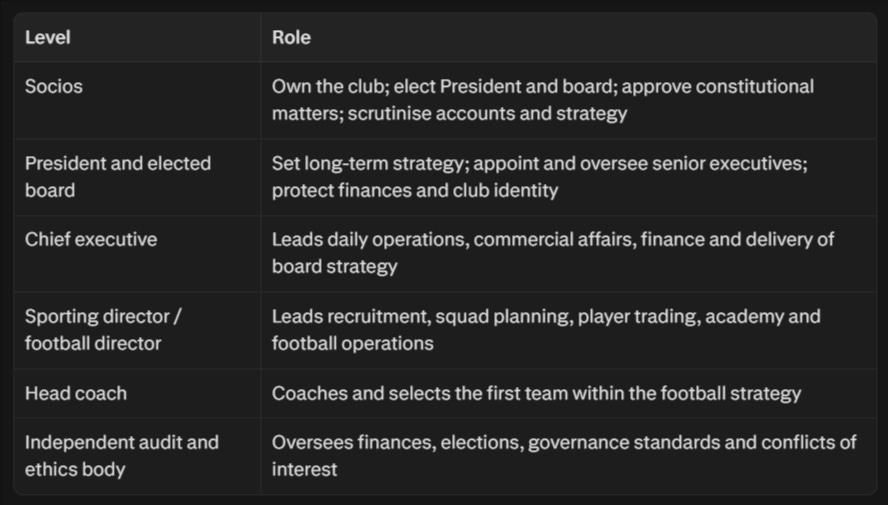
Democratic ownership should create accountability, not an online referendum on every centre-half or every tactical substitution.
Accountability between elections
A six-year election alone would be too blunt. Celtic would need:
An annual members’ assembly and published annual report.
Quarterly financial and strategic updates.
Member questions submitted and answered publicly.
Annual votes on accounts, board remuneration policy and major capital plans.
Independent election, audit and ethics committees.
A clear register of conflicts of interest.
Member-triggered special meetings where a defined threshold is reached.
A high-threshold removal process for serious misconduct or constitutional breach.
A formal supporters’ council representing season-ticket holders, disabled supporters, diaspora members, youth members and supporter clubs.
The contrast with the PLC model is straightforward. Under a PLC, a supporter’s influence is usually limited to whatever shares they own and major voting power can sit with a small group of private investors. Under a socio structure, the person who funds the club through a season ticket, membership and everyday loyalty has a formal constitutional role.
Membership structure
The membership model should separate ownership and democracy from ordinary commercial loyalty benefits. Not everyone who wants a season ticket will necessarily wish to pay for a voting membership, while the club still needs a clear, fair relationship with its ticket base.
The model below gives season-ticket holders a compulsory low-cost ordinary membership, while keeping full socio status voluntary, affordable and meaningful.
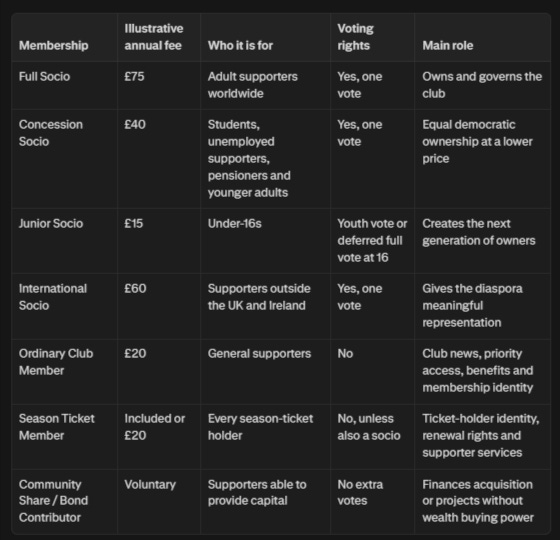
The numbers are for illustrative purposes only rather than a final proposal. The key is that full ownership cannot become a luxury item.
An adult socio fee of £75 is well below Barcelona’s current €225 adult rate. Barcelona’s 2026 adult socio fee is €225, with junior rates of €112 for ages six to 14 and €53 for under-sixes. A lower Celtic price is sensible because Celtic operates in a smaller media market, has a support spread across different incomes and would need mass participation rather than a prestige membership scheme.
Season-ticket holders
Every Celtic season-ticket holder should automatically be an ordinary club member. That membership should be included in the ticket price or charged transparently as a modest annual levy, such as £20, every season.
This would provide:
A verified, permanent relationship between the club and its ticket base.
Priority access to club communications, cup schemes, ticket exchange services and member events.
A direct route to upgrade into full socio membership.
A reliable annual membership income without tying voting rights to the ability to buy the most expensive seats.
A clear distinction between buying access to matches and exercising democratic ownership.
The critical principle is owning a season ticket should not be the only route to becoming a socio. Celtic belongs to supporters across Scotland, Ireland and the world, including those unable to attend regularly. Equally, buying a season ticket should not automatically purchase voting control. A season-ticket holder would need to opt into full socio status, accept the constitution and pay the additional socio fee.
What could it raise?
No one can state Celtic’s true global fanbase with precision. The often-cited public estimates are old and vary materially. Research cited for 2003 placed Celtic’s worldwide support between about nine million and 12 million, and noted more than 800 supporters’ clubs across 60-plus countries. Those figures should be treated as broad indicators of reach and affinity, not a verified count of fans available to pay a membership fee.
A credible business plan must therefore be conservative. It should model paying members, not claim millions of subscribers simply because millions identify as Celtic supporters.
Celtic’s immediate addressable base is more tangible:
A stadium capacity of around 60,000.
A season-ticket base effectively close to capacity
Tens of thousands of individual small shareholders; the Celtic Trust puts the figure at around 27,700.
Large supporter-club and diaspora networks across Ireland, Britain, North America, Australia and elsewhere.
Conservative annual-income scenarios
Assume a mature member model with 55,000 season-ticket holders, and assume all are ordinary club members at £20. Then model full socios separately.

These figures deliberately exclude: Donations, Supporter bonds and community shares, Legacy income, Corporate sponsorship linked to the new model, Event income, Merchandising uplifts, Any ticket-price increase, Any transfer profit, Any UEFA prize money, They are membership-only figures.
The credible target for a well-run launch would be £5m–£9m per season once the model is established. A high-engagement model reaching 150,000 socios worldwide could exceed £10m annually, but that should be treated as an ambition rather than an assumption.
For context, Celtic reported £111m revenue for the year to June 2026, down from £143.6m in the previous year because of Europa League participation after failing to qualify for the Champions League. The club still reported £66.4m in cash at year-end. Membership income would not replace European football revenue, player sales or season-ticket income; it would provide a more predictable recurring stream [annually] and a direct funding source for democratic ownership, club development and supporter-led projects.
Could Celtic operate sustainably?
Yes, but the distinction between operating the club and paying for the ownership transition is crucial. Celtic already operate as a largely self-financing football business. Revenue comes from matchday income, domestic and UEFA media distributions, sponsorship, retail, merchandising, hospitality and player trading. The club’s 2025–26 results show the scale of European football volatility as revenue fell £32.6m, from £143.6m to £111m, when Champions League income was excluded, and the club moved from a £33.9m post-tax profit to a £4.8m loss. Yet it retained £66.4m cash.
That is a strong argument for fan ownership built on financial discipline rather than fantasy spending.
A sustainable financial constitution
The socio club should adopt rules such as:
No dividends, distributions or private extraction of operating profits.
A minimum protected cash reserve, perhaps equivalent to six months of fixed operating costs.
A three-year rolling football budget, not one based on assumed Champions League qualification.
Transfer spending funded from ordinary revenues, amortisation capacity and actual player-sale proceeds.
No borrowing secured against Celtic Park without a supermajority of socios.
No debt to finance routine wages or transfers.
Any acquisition debt held outside the club and capped against predictable membership income.
Annual publication of a football-budget range and cash-reserve policy.
Mandatory member approval for exceptional borrowing, stadium relocation or sale of major club assets.
This does not mean Celtic would never borrow. Borrowing can be sensible for stadium modernisation, training facilities or renewable infrastructure when there is a clear asset, a repayment plan and member approval. It means Celtic would not become another club gambling its future to satisfy the short-term demands of an owner or the short-term impatience of a membership.
The real advantage
Celtic would not need an owner to inject money every year like some clubs, because it already creates substantial revenue. The socio model would ensure that money has only one destination - back into Celtic.
That could include:
First-team recruitment and wage investment.
Academy and women’s-team development.
Barrowfield, Lennoxtown and Celtic Park upgrades.
Ticketing technology, accessibility and supporter services.
Community projects in Glasgow and the wider Celtic diaspora.
Financial reserves against a bad European cycle.
The managed purchase of any remaining historic share capital.
No dividends. No private capital gains. No exit strategy for a billionaire. No need to wait for an individual benefactor to decide whether the club is “deserving” of investment.
The democratic case
The strongest case for a Celtic socio model is not that it would make every football decision correct. It would not. Member-owned Barcelona have made costly errors, accumulated significant debt and shown that democratic structures are no automatic protection against poor executive judgement. The case is that it replaces dependence with rights.
At present, a PLC structure leaves the decisive power with those holding the biggest share blocks, in Celtic’s case Dermot Desmond. The supporter may fill Celtic Park, buy the shirt, travel to Europe, renew the season ticket and keep the club commercially alive, but still hold no guaranteed meaningful say in its direction. A socio system would make the relationship honest.
The supporter would no longer be merely a customer, an atmosphere provider or a balance-sheet line. They would be a contributing member of the club - entitled to vote, entitled to scrutinise, entitled to remove leadership at the next electoral cycle, and entitled to know that no private owner can sell Celtic’s future without the consent of the people it belongs to.
A six-year mandate would give an elected President and board enough time to build properly. Annual reporting, member assemblies, transparent accounts, independent audits and clear recall provisions would ensure they do not become as insulated as the PLC structure they replaced.
The future question for Celtic should not be whether the next millionaire is more generous than the last. We shouldn’t be wanting to replace Desmond with a Haughey. It should be whether a club with this support, this revenue base and this history is finally prepared to trust its own people - its supporters.